



All posts by Julie Gisbon

Effective Reading Comprehension Strategies for Student Success


Reading comprehension requires the ability to understand and interpret text including using key skills like memory, vocabulary, and critical thinking. Some traditional teaching methods may address these areas, however, Lindamood-Bell’s unique sensory-cognitive approach focuses on explicitly developing concept imagery—the ability to create an imaged gestalt (whole) from oral and written language. Concept imagery is the foundation for reading comprehension and critical thinking for individuals of all ages. The following sections offer practical tips for educators working with students at all levels and provide a foundation for understanding weak reading comprehension, including identifying its underlying causes. 


Understanding Reading Comprehension

Reading comprehension involves actively engaging with written material, making connections, and deriving meaning from the text. This skill is crucial for academic success and lifelong learning. To comprehend what we read, one must have adequate concept imagery—the ability to create an imaged whole from written language. At Lindamood-Bell, we provide evidence-based instruction that develops this imagery-language foundation. According to Nanci Bell, co-founder of Lindamood-Bell and author of the Visualizing and Verbalizing® (V/V®) program, “Clinical research and experience over the last 30 years indicate there is a separate comprehension weakness that is rarely identified. This weakness often undermines the reading process…It is weakness, based in the sensory system, in creating an imaged gestalt.”

Students with weak reading comprehension may be able to decode words accurately but cannot understand what they read. This weakness also affects oral language comprehension. For example, students may struggle with following directions and have poor short-term and long-term memory skills. Unfortunately, these weaknesses can come across as a lack of effort or motivation on the part of the student and may go undiagnosed. 

Difficulty creating an imagined gestalt–weak concept imagery– causes individuals to get only “parts” of information they read or hear, not the whole. Individuals of all ages may experience the symptoms of a weakness in concept imagery. This causes weakness in:

  • Reading comprehension
  • Listening comprehension
  • Critical thinking and problem-solving
  • Following directions
  • Memory
  • Oral language expression
  • Written language expression
  • Grasping humor
  • Interpreting social situations
  • Understanding cause and effect

The Visualizing and Verbalizing program develops concept imagery—the ability to create an imagined or imaged gestalt from language—as a basis for comprehension and higher-order thinking. The development of concept imagery improves reading and listening comprehension, memory, oral vocabulary, critical thinking, and writing.


Eight Tips to Enhance Reading Comprehension Strategies

reading comprehension strategies for teachers

Have you helped students improve their phonemic awareness, phonics, and word recognition, only to see them struggle with reading comprehension? Many students experience reading comprehension weakness despite having adequate decoding and vocabulary skills. While educators often implement various comprehension strategies, they may sense something crucial is still missing.

Lindamood-Bell’s sensory-cognitive approach to language and literacy addresses this gap by focusing on concept imagery. This process, known as imaging a gestalt, forms the foundation for reading and oral language comprehension.

The National Reading Panel Report (2000) identifies imagery as a research-based strategy for improving comprehension. Applying concept imagery to reading comprehension helps students build mental models that support higher-order thinking skills like identifying the main idea, making inferences, drawing conclusions, predicting outcomes, and evaluating information. Effective strategies for developing these mental models include checking for vocabulary, activating background knowledge, and questioning students about what the words they read make them picture.

These eight tips will help you apply concept imagery to reading comprehension.

  1. Introduce explicit instruction to develop concept imagery.
  2. Pre-check unknown vocabulary. 
  3. Activate background knowledge. 
  4. Monitor for comprehension. 
  5. Ask students for a word summary. 
  6. Check for imagery and understanding. 
  7. Use imagery for higher-order thinking questions.  
  8. Model the thinking process.


Introduce Explicit Instruction to Develop Concept Imagery

Improving reading comprehension starts with explicit instruction in concept imagery—teaching students how to create mental images of the language they read. Often, we assume that students can create mental images when this is not the case.

Introduce the idea of imagery or visualization with a student-friendly term like “picture.” Describe how words on the page turn into pictures in their mind. When a student reads silently or aloud, ask them what the words make them picture. Be specific. For example, ask, “What did you picture for the skyscraper?” or “What do you picture for the people signing the Declaration of Independence?” As Nanci Bell states in the VV® program manual, for many students, explicit instruction will need to start from the one-word level, to “develop the student’s ability to create mental representations for a word, thus laying the foundation for more language: a phrase, a sentence, or a paragraph.” 


Pre-check Unknown Vocabulary 

Scan the text and identify key terms that may be challenging or unknown. Ask your students if they have a picture for those words. Use an age-appropriate dictionary to teach them the meanings. Help students develop a specific, concrete mental image for each word by providing them with choices, such as “Is the man’s sweater blue or brown,” or “Do you picture a young woman or an old woman?”

At Lindamood-Bell, we recognize the importance of vocabulary in reading comprehension. Our evidence-based program, Visualizing and Verbalizing, develops vocabulary and reading comprehension using concept imagery techniques.


Activating Prior Knowledge

Prior knowledge plays a role in reading comprehension. It refers to the information and experiences readers already possess about a topic. Activating prior knowledge helps students make connections between what is known and new information, enhancing understanding. 

Check for imagery and understanding of words or concepts that may activate prior knowledge. For example, if students are reading a story that takes place on a deserted island, you could ask your students if they have ever been to an island, do they know what to picture for an island, and how they can picture it as deserted. Again, ask questions that include choices. For example, “Do you picture the island covered in sand or rocks?” 


Monitoring Comprehension

Monitoring comprehension is a crucial skill for effective reading. It involves being aware of one’s understanding of the text and actively taking steps to clarify and improve comprehension. 

To help develop this skill, first have students read text aloud so you can also monitor for decoding accuracy and fluency. Prompt students to actively check they are visualizing the text as they read. If they miscall a word that affects the meaning, your first question should be, “What does that make you picture? Does that make sense?”

Readers can imagine characters, settings, and events, connecting with the text on a deeper level.


Ask Students for a Word Summary 

After reading the text, ask the student to give a verbal summary in their own words (a word summary). This will be your first assessment of whether they recalled the relevant details and sequence and understood the passage. Students may initially struggle with accurate word summaries, perhaps only giving a few details, but improve with practice and more attention to their imagery. As they become more skilled with verbal word summaries, extend the lesson to written word summaries.


Check for Imagery and Understanding 

Teach students to visualize the text and create mental images. This technique enhances reading comprehension and retention of information. Ask students questions about key information from the text. Teach students to actively check their imagery and question them for important details to make their image concrete, such as size, shape, color, movement, and background. 


Use Imagery for Higher-Order Thinking Questions  

Prompt students to use their imagery as a foundation for higher-order thinking skills. Higher-order thinking (HOT) questions require a more complex understanding of the text beyond basic facts and details. These include Main Idea, Inference, Conclusion, and Prediction. Prompt students to use their imagery as a foundation for higher-order thinking beginning with the main idea. For example, “Based on what you pictured, what do you think the main idea is?”


Model the Thinking Process

Demonstrate effective reading comprehension strategies by thinking aloud while reading. This allows learners to observe and internalize the thinking process.

Provide examples from your imagery, especially for more complex and abstract text. When possible, use new vocabulary to increase your students’ word knowledge. Start your example with the words, “I pictured. . .”

To learn more about using imagery to enhance comprehension strategies, access our Toolkit for Educators to download our guide, “8 Tips to Enhance Comprehension Strategies.”


Case Study: Improving Reading Comprehension for Elementary School Students 

improving reading comprehension strategies for elementary school students

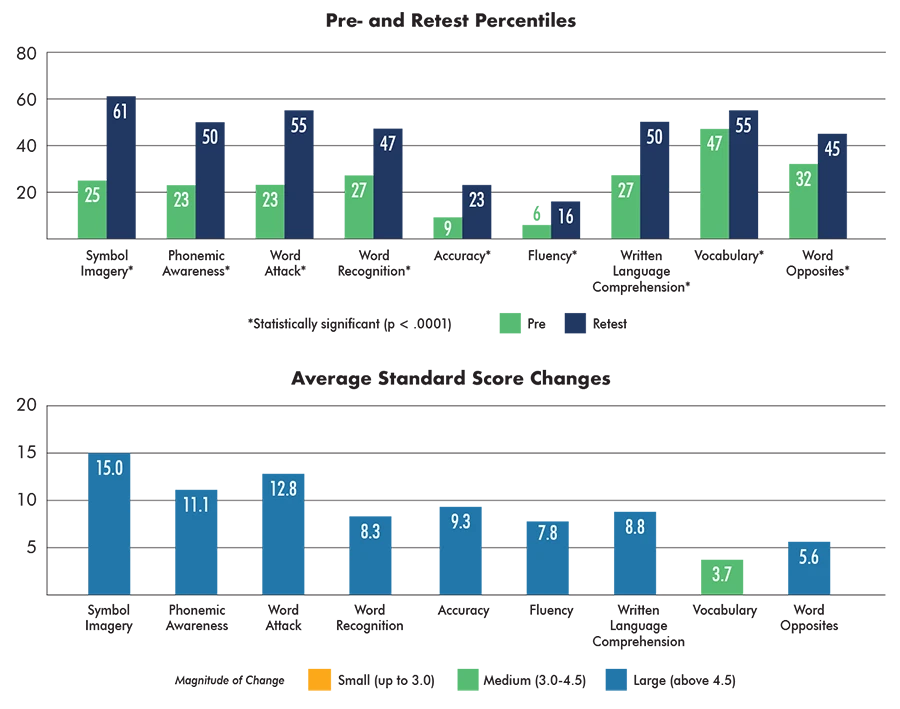
Students who struggle with comprehension benefit from the Visualizing and Verbalizing (VV) for Language Comprehension and Thinking program. The program provides explicit and systematic instruction for developing concept imagery and has been shown to significantly improve reading and listening comprehension. Fort Smith Public Schools in Fort Smith, Arkansas serves a large percentage of students who are at risk of reading failure. During the 2020-21 school year, Fort Smith Public Schools implemented Lindamood-Bell instruction to address the specific needs of this student population. A group of 97 students received an average of 52 hours of Visualizing and Verbalizing instruction. Instruction was delivered by Fort Smith Public Schools’ teachers who received professional development in the programs. Student gains were measured with a battery of assessments.

comprehension instruction results for elementary school students

RESULTS: On average, Visualizing and Verbalizing students achieved statistically significant, large standard score gains in Reading Comprehension. The percentile growth shows these students moved from below the normal range into the normal range (25th-75th percentile). The results of this study illustrate that instruction in the Visualizing and Verbalizing program developed by Lindamood-Bell’s founders leads to improved comprehension, which is essential to achieving success with school curricula.

 PROFILE: Reading Comprehension

Number of Students: 97
Average Age: 12.1
Average Hours of Instruction: 52
Lindamood-Bell Programs Implemented: Visualizing and Verbalizing

Outcome Measures:
• Peabody Picture Vocabulary Test (PPVT)-4th/5th (vocabulary)
• Gray Oral Reading Tests (GORT)-4th (accuracy, fluency, comprehension)

View more results and case studies of our work with schools.


Educator Insights

Listen to educators from Fort Smith Public Schools share how Lindamood-Bell Professional Development has helped them make a meaningful impact on their students’ learning.


Support for Educators

workshops for reading comprehension strategies

Ready to go beyond the tips in this blog? Lindamood-Bell proudly offers educators professional development in our highly successful and proven programs. Our workshops, available both in person and live online, provide in-depth training to enhance instructional practices and improve student outcomes. Schools can partner with us for in-services, job-embedded coaching, and comprehensive school partnerships.

Contact Lindamood-Bell today. Call us at 800-233-1819 OR Click here to schedule a brief consultation with a program expert to discuss your intervention needs. We are excited to teach you how to improve your students’ reading comprehension and unlock their full potential!

Special Education Administrators share best practices in the Science of Reading


We’re excited to invite you to an informative pre-conference workshop at the national CASE Conference in Savannah, Georgia, on November 6.


Workshop: Scaling Up a District-Wide Literacy Intervention
Topic: Building Structures to Support Special Education Teachers in Implementing with Fidelity and Closing Gaps
Time: 9:00 – 11:30 A.M.


Jennifer Thompson, IRR Instructional Coordinator with Fulton County School District’s Services for Exceptional Children, will share insights from the district’s seven-year collaboration with Lindamood-Bell. 

Beginning in 2017, Fulton County Schools, a district of 90,000 students, began scaling up a district-wide literacy initiative to respond to the lack of consistent reading instruction by their special educators. The district selected a program focused on developing the underlying sensory-cognitive functions students need to learn to read. Over time, and through the pandemic, the district created structures in real-time in response to the needs of students, teachers, and district leadership that have resulted in identifiable changes in the performance of special education students’ reading scores, including in the district’s most struggling schools.

This presentation will outline why Fulton County determined the need to change its literacy instructional practices for special education students, what it wanted from a literacy professional development provider, who it identified as the necessary stakeholders, how it supported them in their roles, and how the implementation has continued to evolve from the initial design. Data showing Fulton County’s special education students’ positive growth in closing the reading gap with their general education peers will be shared.

Don’t miss this opportunity to hear how the district successfully scaled up this important initiative! 


Unable to attend?
If you’re interested in learning more about this initiative and its positive impact on struggling readers, please reach out to Dave Kiyvyra, Director of Development at Lindamood-Bell for Schools, at dave.kiyvyra@lindamoodbell.com or use this link to set a time to meet.

Catch Up or Get Ahead With Evidence-Based Math Instruction

Parents and teachers often worry about students falling behind in math, whether due to school disruptions or challenges with the subject itself. If your child is struggling with math, Lindamood-Bell can help them catch up and build confidence in their math skills.

We offer personalized math instruction designed to help students reach their full potential—no matter their age or prior difficulties. Whether it’s foundational skills or more advanced concepts, we provide a comprehensive approach to math that stimulates an individual’s ability to visualize and verbalize the processes behind mathematical reasoning.


What Makes Our Math Instruction Unique?

Our evidence-based On Cloud Nine: Visualizing and Verbalizing for Math program integrates concept and numerical imagery with language to enhance both computation and problem-solving. Students not only learn how to solve problems but also understand the reasoning behind them. This dual focus on mathematical reasoning and computation helps students build a solid foundation in math, leading to greater success in the classroom.

Key Focus Areas:

  • Learning math facts: Our instruction stimulates an individual’s ability to image and verbalize the concepts behind math processes using an imagery-language foundation, which helps students visualize and master essential math facts.
  • Solving word problems: We integrate concept and numerical imagery with language, enhancing both problem-solving and reasoning skills, allowing students to confidently approach and solve word problems.
  • Understanding math concepts: Through the imagery-language foundation, students not only learn how to compute but also develop a deeper understanding of the reasoning behind math concepts, solidifying their foundation for future success.


Real Results for Students

We’ve seen tremendous success stories from students who once struggled in math. Hear from Nikki, a mother whose son Bryson was falling behind:
“He started getting very low scores on his math tests. After receiving instruction at Lindamood-Bell, he’s now describing himself as a good math student again. He’s back on track in math!”

Watch their story here:

Our math instruction is backed by peer-reviewed research, showing its effectiveness in helping students succeed. Explore our math instruction results and see the research supporting the On Cloud Nine program.


Get Started Today!

Whether you’re looking for in-person or live-online instruction, Lindamood-Bell’s math programs are available to students anywhere, anytime. Our flexible live-online option brings personalized instruction right to your home, making it easier than ever to help your child succeed in math.

Call us at 800-300-1818 to learn more and schedule instruction.


“My Seven-Year-Old With Dyslexia Is Reading!”

When Roan started school, his mother, Ruth, noticed he was struggling with reading and was frustrated. “He was coming home crying and angry,” she says. He was diagnosed with dyslexia shortly after, unable to read even one word.

Then Ruth turned to Lindamood-Bell’s evidence-based instruction to develop Roan’s reading skills. Soon, Roan was reading at grade level!


Watch to hear Ruth and Roan’s story.


With our personalized programs, students can make years of improvement in literacy and learning skills in a matter of weeks.  


How can your child excel this school year? Read on for typical areas of focus. 

Reading 

Strong readers recognize common words and can sound out unfamiliar words easily, making reading at grade level or above easy and smooth.

Students struggling can learn to read to their full potential this school year. We identify why reading is hard for each student individually and focus on developing the skills they need to become a better reader. Learn about our renowned approach.


Comprehension 

Do words “go in one ear and out the other” for your child? This is more common than you’d think. Weak concept imagery—the ability to image a gestalt (whole)—may be the cause. Weakness in concept imagery interferes with reading and listening comprehension, memory, oral vocabulary, critical thinking, and writing. Developing concept imagery can improve comprehension. Learn more about how we develop comprehension here.


Math 

Does your child “hate” math? People who are good at math can easily visualize math concepts. The language of numbers turns into imagery, and they “see” mathematical relationships. We can teach your child how to think with numbers. Learn how we solve math “problems” here. Individuals of all ages can learn to enjoy math!  

Contact us at 800-300-1818 to get started.


Watch our Special Parent Forum


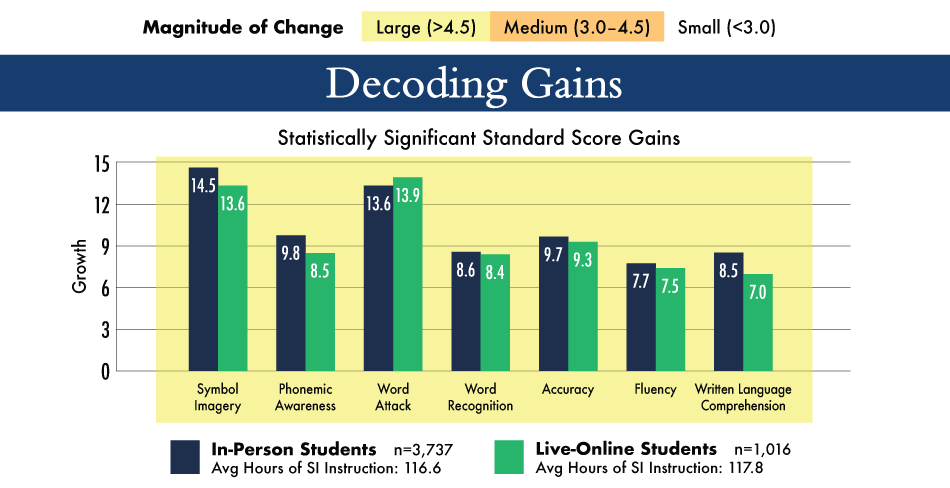
Emmy’s mom, Alyson, discussed her bright and energetic kindergartener’s struggles with reading and spelling and how online instruction helped her catch up. Lindamood-Bell’s Director of Research and Development, Paul Worthington, reviews how student gains from online instruction are equivalent to gains from in-person instruction.

Click here to hear about Emmy’s amazing success story.


Study on Reading Interventions for Students with Reading Difficulties Launched, Details to Be Presented at SREE 2024 Conference

Lindamood-Bell and American Institutes for Research® (AIR®) Collaborative Study to Examine Effectiveness in Reading Intervention Program for Elementary Students

SAN LUIS OBISPO, Calif.Sept. 19, 2024 /PRNewswire/ — A groundbreaking study aimed at improving reading outcomes for upper elementary students with reading difficulties has officially launched and will be presented at the Society for Research on Educational Effectiveness (SREE) 2024 Conference. The presentation, titled “An Efficacy Study of the Lindamood-Bell Learning Processes Complete Reading Intervention for Upper Elementary Students,” will be delivered on September 20 by presenting author Jill Bowdon of the American Institutes for Research. Additional study authors include American Institutes for Research® (AIR®) research experts Anja Kurki, Ph.D.Billie Jo Day, Ph.D.Daniel D. Hubbard; and Lily Tahmassebi. Attendees at this prestigious conference include education researchers, policymakers, and practitioners who will explore the latest advancements in educational research and intervention strategies.

The research initiative, developed and conducted by AIR® in collaboration with Lindamood-Bell, addresses a critical challenge in education today: the reduced emphasis on foundational skills and increased focus on comprehension in upper elementary grades, which poses difficulties for students with reading disabilities. These students often lack the basic reading skills their peers developed in earlier grades, putting them at risk of falling behind in reading and all academic subjects.

The study will provide empirical evidence on the impact of the Lindamood-Bell Learning Processes Complete, a multicomponent intervention designed to improve reading skills for students in Grades 3-5 who are at risk for reading difficulties or have been identified with reading disabilities. As part of the program, the Lindamood-Bell for Schools division will provide professional development services to 300 educators in approximately 50 mid-sized to large urban public elementary schools with diverse student populations, representing three districts and approximately 900 students. The randomized controlled trial will evaluate the effectiveness of the Lindamood-Bell Learning Processes Complete Intervention systems in real-world educational settings.

Since 2019, 46 states have enacted reading policy reforms designed to ensure students are fluent readers by 3rd grade. Despite these efforts, many interventions fail to adequately address the needs of students who remain at risk at upper elementary levels. This study aims to bridge that gap, examining how the Lindamood-Bell Learning Processes Complete significantly improves outcomes for students in need of targeted support.

“This study and our partnership with American Institutes for Research is a significant milestone for Lindamood-Bell and educational research,” says Paul Worthington, director of research and development for Lindamood-Bell. “With the launch of this research initiative, we have the opportunity to demonstrate the impact of our evidence-based, neuroscientific, sensory-cognitive interventions in real-world school environments. This study has the potential to create a paradigm shift, expanding beyond the science of reading to encompass the broader cognitive science of learning.”

The presentation at the 2024 SREE Conference will describe the research program’s objective, methodology, expected impact, and recommendations for future research. The full results of the study will be shared after all data has been analyzed after the conclusion of the program at the end of the 2025 academic year.

About Lindamood-Bell Learning Processes
Lindamood-Bell believes that all children and adults can learn to read and comprehend to their potential. For nearly 40 years, their evidence-based instruction has changed the lives of individuals with learning challenges such as dyslexia, ADHD, and autism. In addition to their 50 Learning Centers, they provide professional development for educators worldwide and engage in peer-reviewed research with universities, including MIT and Stanford. Visit www.lindamoodbell.com to learn more.

Contact: 
Paul Worthington,
Director of Research and Development
Lindamood-Bell
383538@email4pr.com  
(805) 541-3836

Lindamood-Bell Academy: Enroll Now for Special Savings

Lindamood-Bell Academy’s highly personalized approach is designed to meet the unique learning needs of each student. We develop the imagery-language foundation to help each student read, comprehend, and do math to their potential. 

Academy is an accredited California K-12 private school combining renowned, evidence-based instruction with a standards-aligned curriculum for maximum learning success. But it is our individualized, dynamic, and positive instruction that truly makes the difference for your child. Focusing on each student’s sensory-processing ability leads to successful learning and critical thinking. 

Shari, mother of an Academy student, said this about her son: “Lindamood-Bell Academy has given my child a future, and that is a gift. What they are doing here is giving Oliver the future he would not have otherwise. It makes me feel good as a parent because I know I’m doing the best that I can for him and that he is getting what he needs.”

Explore other stories about real students of the Academy here. There’s simply no other school like us or with our success rates!  

Enroll now for next school year and receive 25% off a month of tuition! 

*Academy enrollment must be completed by August 16, 2024. Must enroll for the entire school year. The discount will be applied to the final month of tuition in May 2025.

Call 800-300-1818 to learn more or get in touch to enroll.

Get to Know Our Unique Academy—Virtual Tour


At Lindamood-Bell Academy, we develop sensory-cognitive processing as a foundation to help students read, comprehend, and do math to their potential. Why is this important? Because students need high-functioning sensory-cognitive processing to learn how to think and reason. They then apply their new abilities to not just school content, but life.


Our highly successful, unique approach to school is personalized to meet the learning needs of each student. Expect engaged, dynamic staff using evidence-based instruction and a standards-aligned curriculum to achieve results in just weeks!


See for yourself how Academy guides students to success in this virtual tour:


Call 800-300-1818 with any questions! 

At Lindamood-Bell, We Offer Learning Services that are as Unique as Your Child!

Lindamood-Bell is your partner in education. In addition to our one-to-one instruction, we offer learning support that is tailored to your child’s unique needs.


Group Instruction at Lindamood-Bell:

Our group instruction model is designed to cater to students’ diverse learning needs by providing tailored educational experiences in a collaborative setting. We use our founders’ evidence-based programs to address the underlying sensory-cognitive functions necessary for reading and comprehension. By working in small groups, students benefit from peer interaction and collaborative learning while receiving individualized support to reach their full potential.

To learn more about group instruction for your child, call your local learning center at 800-233-1819.


Application of Sensory-Cognitive Skills:

Well-developed sensory-cognitive processing is the foundation of learning. Our instruction develops phonological awareness, symbol imagery, and concept imagery. These skills are integrated into classroom content to improve students’ reading, comprehension, and critical thinking abilities. For example, phonological awareness activities help students decode words more efficiently, while symbol imagery strengthens their ability to visualize and recall information. Concept imagery aids in understanding and retaining complex concepts, ensuring that students can apply their knowledge across various subjects.

To learn more about application to classroom content instruction for your child, call your local learning center at 800-233-1819.


Lindamood-Bell Academy:

Lindamood-Bell Academy is our private school dedicated to providing personalized education to students with diverse learning profiles. Our Academy combines Lindamood-Bell’s renowned instructional programs with a comprehensive curriculum to offer a well-rounded educational experience. We create individualized learning plans for each student, ensuring that their unique needs and strengths are addressed. Our goal is to help students achieve academic success and develop the confidence and skills necessary for lifelong learning.

To learn more about Lindamood-Bell Academy for your child, call your local learning center at 800-233-1819.


Join Us for a Special Live Forum on July 24th

From Our Families to Yours: Parent Insights on Comprehension Instruction at Lindamood-Bell

Abbie’s Mom, Beth, will discuss her teenage daughter’s experience with  Lindamood-Bell instruction and how her improved skills enabled her to thrive despite extreme challenges.

Wednesday, July 24

10 AM PDT • 1 PM EDT • 6 PM BST

Register Now


Leverage American Rescue Plan for Literacy Growth with Lindamood-Bell PD


Relief funding from Congress includes over $100 billion in support of K-12 schools. 

Take advantage of these funds to get students back on track and boost literacy achievement with Lindamood-Bell Professional Development.


Lindamood-Bell Professional Development builds teacher expertise in literacy instruction 

  • Evidence-based programs supported by the cognitive science of reading
  • In-person and online workshops and job-embedded professional development
  • Interventions for MTSS, K-12, including dyslexia


Lindamood-Bell Tutoring Corps offers high-impact tutoring to accelerate learning

  • Training for your teachers, paraprofessionals, tutors
  • Or instruction provided by the Lindamood-Bell Tutoring Corps
  • In-person or online tutoring (where available)


Elementary and Secondary School Emergency Relief (ESSER) Funding Opens Up Exciting Opportunities to Increase Achievement for All Students

Guidance from the Education Department on the use of relief funds includes strategies to address lost instructional time, particularly for students already underserved when the pandemic hit.

Relief funds are intended to provide services that will accelerate learning through instructional approaches, tutoring, and expanded learning time. Lindamood-Bell’s instructional approach and services align with ESSER strategies to increase achievement.


Lindamood-Bell partners with schools to provide evidence-based interventions for students. We deliver levels of professional learning for educators to help increase student achievement. We have extensive experience in working with diverse school districts and student populations. Our partnerships include pilot programs to large-scale school and district-wide implementation.


To learn more or to set up a free online overview of our programs and PD options

Contact us

or call 800.233.1819 for more information.


Lindamood-Bell is a qualified member of proventutoring.org.


Personalized Learning Makes a Huge Difference

Have you considered how personalized learning could make a huge difference for your child this school year? Many families come for instruction in the fall and take advantage of savings available during the school year.

Learn more, save more

Enjoy up to 15% off instruction when you secure your child’s schedule. The discount rate varies from 5%-15% off, depending on the amount of total sessions scheduled. The more you schedule, the more you save!

Save on any type of Lindamood-Bell instruction

Student instruction can focus on reading, math, and/or comprehension, wherever your child needs help. Savings apply to our renowned sensory-cognitive instruction, after-school homework help, and more.

Save everywhere

Savings apply for in-person and Online Instruction during the school year only. Choose what works for you!

New to Lindamood-Bell?

If school is hard for your child, you need to know why. Identifying strengths and weaknesses is the first step toward helping a child. A learning evaluation will uncover the underlying challenges affecting school performance. In a thorough results consultation, we will discuss an individualized learning plan to make school easier and more successful for your child.

Watch how one mom experiences receiving help at Lindamood-Bell. She describes the effects of instruction on her son’s learning ability and self-esteem, as well as the positive impact on the entire family.

To find out more about the Learn More, Save More offer and to get started, call us!

Double Bay (02) 9328 7119  ~ Chatswood (02) 9410 1006