





post
BLOG AND NEWS

Tips for Students with ADHD

Sep 10, 2026


Attention Deficit Hyperactivity Disorder (ADHD) is a common neurodevelopmental disorder that affects many students, impacting their ability to focus, stay organized, and manage time effectively. However, it’s crucial to recognize that these attention deficits may not exist in isolation. Sometimes, students with ADHD may also face additional learning challenges. Many students with ADHD are diagnosed without a thorough examination of their underlying learning profiles, which could be contributing to their attention challenges. 


At Lindamood-Bell, we believe in addressing the root causes of learning difficulties through customized interventions that consider the whole child, not just the symptoms. Our approach is grounded in the understanding that effective support for students with ADHD begins with a comprehensive assessment and personalized instruction plan designed to strengthen student’s learning abilities.


Understanding ADHD in Students

Tips for students with ADHD

Students with ADHD may have a diminished ability to concentrate, manage impulses, and stay organized, all of which are critical skills for academic success. These challenges can manifest in various ways, including:


  1. Difficulty staying focused on tasks: Students with ADHD may find it hard to pay attention to lessons, complete assignments, or follow through on tasks.
  2. Impulsivity: Students with ADHD might act without thinking, which can lead to difficulties in social interactions and classroom behavior.
  3. Disorganization: Students with ADHD can face significant hurdles in managing time, keeping track of materials, and following schedules. 


These challenges can have a profound impact on the academic performance of students with ADHD, often leading to frustration, low self-esteem, and disengagement from learning. 


Tips for Students with ADHD

Tips for students with ADHD, start with an evaluation.


1. Evaluate Student Learning

Often, students with ADHD face additional learning difficulties that can exacerbate their attention challenges. At Lindamood-Bell, our transformative approach begins with a thorough Learning Ability Evaluation. This evaluation uncovers any underlying learning issues, providing a clear understanding of your child’s needs and how best to address them. We then create a personalized instruction plan tailored to each student’s unique learning profile, targeting the root causes of their learning difficulties. Discover how Lindamood-Bell can make a lifelong difference in your child’s education—schedule a Learning Ability Evaluation today. Learn more and book your evaluation.


2. Creating a Supportive Learning Environment

To help students with ADHD thrive, it’s essential to create a learning environment that supports their needs. Here are some strategies:

  • Establish Consistent Routines and Schedules: Consistency helps students with ADHD know what to expect, reduces anxiety, and improves focus.
  • Set Clear Expectations for Behavior and Performance: Clear guidelines provide students with a framework for success, helping them understand what is expected of them.
  • Implement Strategies to Minimize Distractions: Reducing environmental distractions, such as noise or clutter, can help students with ADHD maintain concentration during lessons.


3. Effective Study Techniques for Students with ADHD

Students with ADHD benefit from study techniques that help them organize their thoughts, manage their time, and stay engaged with the material.

  • Organizational Strategies for Better Time Management: Tools like planners, to-do lists, and timers can help students with ADHD break down tasks and manage their time effectively.
  • Techniques to Improve Concentration During Studying: Short, focused study sessions with regular breaks can help maintain attention. Active learning techniques, such as discussing concepts or teaching them to others, can also be effective for students with ADHD.
  • Using Visual Aids: Visual aids such as charts and diagrams can make learning more engaging and help students retain information.


4. Building Motivation and Self-Confidence

Supporting students with ADHD goes beyond academics. It’s important to foster their self-esteem and encourage a positive attitude toward learning.

  • Identifying and Leveraging Individual Strengths: Every student has unique strengths. Identifying these can help boost their confidence and motivation.
  • Encouraging Self-Advocacy and Self-Monitoring: Teaching students with ADHD how to recognize and communicate their needs effectively is a crucial skill for lifelong success.
  • Recognizing and Celebrating Achievements: Regular recognition of accomplishments, no matter how small, helps build a positive self-image.


5. Collaborating with Teachers and other Professionals

A strong support system is vital for the success of students with ADHD. Collaboration between educators, parents, and professionals ensures that the student receives consistent support across all environments.

  • Effective Communication Strategies with Educators: Regular communication between parents and teachers ensures that strategies are aligned and the student’s needs are met.
  • Promoting a Collaborative Relationship between Home and School: Parents and teachers working together can create a more supportive and understanding environment for a student with ADHD.
  • Get Help from Experienced Professionals: Engaging with professionals who specialize in helping students with ADHD and learning challenges can provide additional support and guidance.


Find Support to Improve Learning for Students with ADHD
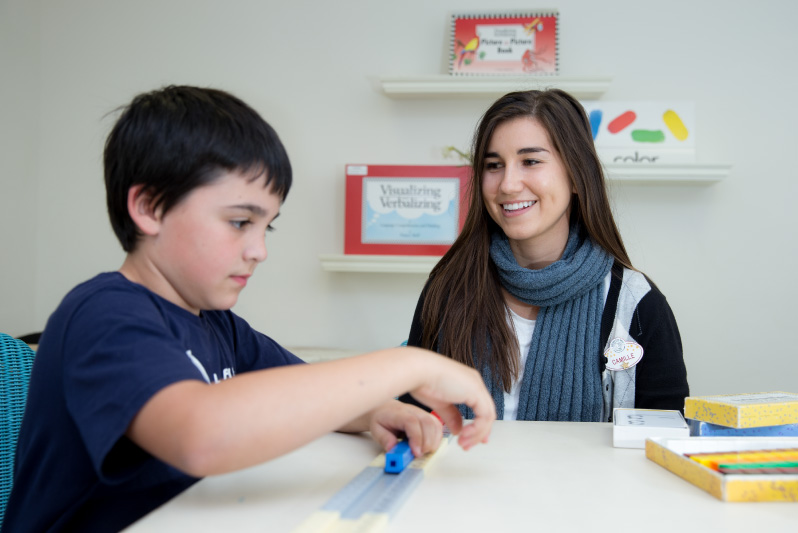
Instruction to support students with ADHD

At Lindamood-Bell, we understand the unique challenges that students with ADHD face in their learning journey. Our instruction is designed to improve foundational learning skills for students with ADHD. We use evidence-based programs, such as  Seeing Stars and Visualizing and Verbalizing, to target the underlying cognitive skills necessary for reading, comprehension, and math, helping students with ADHD improve academically and gain confidence. Our personalized and flexible learning environment meets the unique needs of each student, ensuring they receive the support they need to thrive.

With proven methods and techniques, Lindamood-Bell has been supporting students with ADHD for years. Our programs have a track record of success, helping students overcome learning difficulties and achieve their full potential.

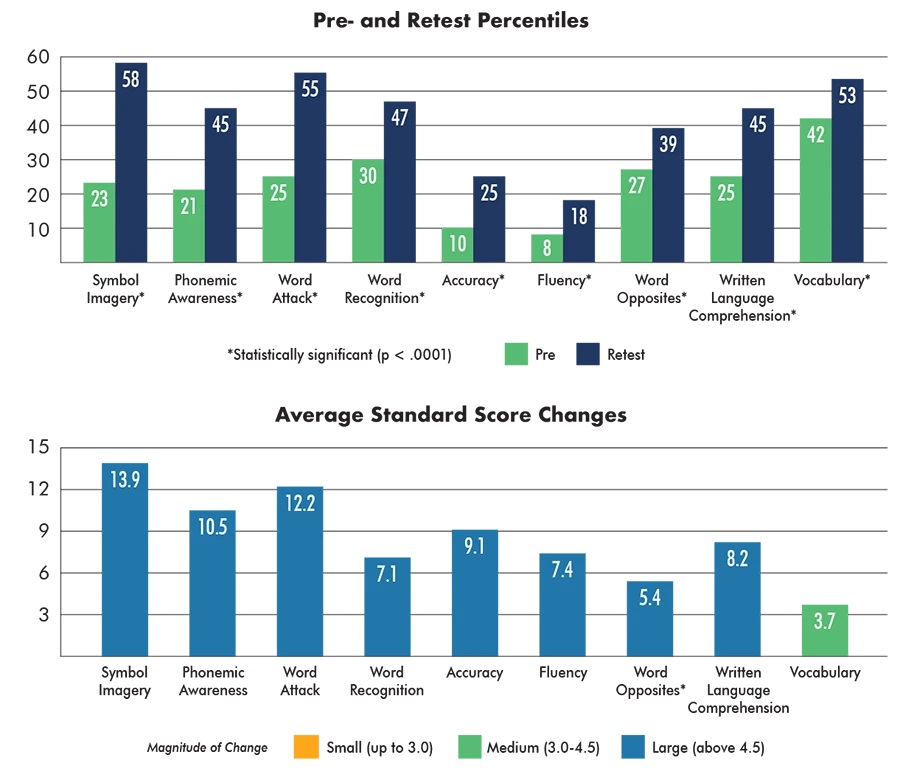
Students with a Prior ADHD Diagnosis Who Received Decoding and Comprehension (Combined) Instruction
ADHD student results for reading and comprehension

Students with a prior ADHD diagnosis, who had both decoding and language comprehension difficulties, received both Seeing Stars and Visualizing and Verbalizing instruction. These students achieved significant improvements in decoding and comprehension. They made large (statistically significant) standard score changes on eight of nine measures.

Years: Jan. 2008 – Dec. 2023
Number of Students: 2,136
Average Age: 11.9
Average Hours of Instruction:  155.4
Lindamood-Bell Instruction Implemented: Seeing Stars and Visualizing and Verbalizing


Find additional Learning Center data, including growth made by students with Specific Learning Disabilities and Autism, here.  The Child Mind Institute is an excellent resource for information to help children who have learning and attention challenges, including students with ADHD. Visit their website at https://childmind.org/topics/adhd-attention-problems/.


Success for Students with ADHD at Lindamood-Bell


One of Lindamood-Bell’s key advantages is our ability to provide personalized and flexible learning environments. We understand that every student is unique, and we tailor our instruction to meet their specific needs. Our one-on-one instruction allows us to address the individual challenges faced by students with ADHD.

Don’t just take our word for it—hear success stories from Lindamood-Bell students with ADHD. These stories showcase the progress and achievements that can be made with the right support and instruction.


For more information on how Lindamood-Bell can support your student with ADHD, contact us today. Together, we can build a brighter future for your child. Call us at 800-233-1819 or request information

Connect with us
🎉 40 Years of Changing Lives Through Learning

📚 2006: What happens when an entire school district works to improve reading?

In 2006, researchers from Texas A&M University published a study in the American Educational Research Journal examining reading achievement in Colorado’s Pueblo School District 60, where Lindamood-Bell had been working with schools since 1997 to support students at risk of reading difficulties.

They examined reading scores for students in grades 3–5 over several years and found that schools using Lindamood-Bell instruction made significantly greater gains than schools across Colorado. Those gains increased over time, including in Title I schools.

It was encouraging to see these results, especially in a district where so many students needed additional reading support.

Follow along as we celebrate 40 years of changing lives through learning.

Tap the link in our bio, @lindamoodbellofficial,  to learn more about our work and research.
📣 FREE Halloween Download for Parents and Teachers, courtesy of Gander Publishing! 🎃
The Imagine That! Halloween lesson packet features four high-imagery stories written at a 2nd–5th-grade reading level.

👻 Enjoy stories about a giant pumpkin, a ghost, and even a rooster accused of being a witch!
🎃 Build reading comprehension with higher-order thinking questions.
🍬 Strengthen vocabulary skills with engaging activities.

Perfect for use with Visualizing and Verbalizing® or any student who could benefit from extra comprehension practice.
Download your free packet and bring some Halloween fun to reading! Follow the link in our bio, @lindamoodbellofficial
🎉 40 Years of Changing Lives Through Learning

🧠 2004: Georgetown University researchers publish an important study on adult dyslexia and Lindamood-Bell instruction.

Led by Dr. Guinevere Eden and published in the scientific journal Neuron, the study used brain imaging to examine changes in adults with dyslexia following eight weeks of intensive Lindamood-Bell instruction.

Researchers found improvements in reading skills along with changes in brain activity, showing that the adult brain can continue to change and develop with reading instruction.

More than 20 years later, these findings continue to offer hope for adults who struggle with reading.

For more about our evidence-based reading instruction, follow the link in our bio, @lindamoodbellofficial.

Follow along as we celebrate 40 years of changing lives through learning!
🎉 40 Years of Changing Lives Through Learning

Our next milestone takes us to 2002, when Lindamood-Bell reached another exciting first!

🇬🇧 2002: Our first international Learning Center opens in London, England.
The opening of our London Learning Center meant more children could benefit from individualized instruction to strengthen their reading and comprehension skills. It was another meaningful step in helping more students learn to their potential.

Follow along as we celebrate 40 years of changing lives through learning.

Explore Lindamood-Bell at the link in our bio, @lindamoodbellofficial.
🎙️ New Podcast Episode: Supporting At-Promise Students

In this episode, we’re joined by Khieem Jackson, Managing Director of Reaching At-Promise Students Association (RAPSA), for a thoughtful conversation about helping at-promise and opportunity youth thrive.
Together, we explore how the words we use to describe students can shape their experiences, and how literacy and learning can open doors to new opportunities beyond the classroom.

🎧 Listen and subscribe at the link in our bio, @lindamoodbellofficial.
Lindamood-Bell will be at the International Dyslexia Association 2026 Annual Reading, Literacy & Learning Conference, November 12–14 in Las Vegas.

Join Paul Worthington, Director of Research and Development, for “ADHD and Dyslexia: Untangling the Comorbidity Conundrum,” which examines research on co-occurring ADHD, dyslexia, and language-processing difficulties, as well as implications for intervention.

📅 November 12–14
📍 Las Vegas + virtual attendance available

Learn more about our presentation and where to find us at the conference at the link in our bio, @lindamoodbellofficial.
🎉 40 Years of Changing Lives Through Learning

📚 2000: Lindamood-Bell partners with juvenile justice schools in San Diego, California, for Project of Hope.

Through this partnership, Lindamood-Bell provided intensive reading and comprehension instruction to young people in the juvenile justice system.
Using the Seeing Stars® and Visualizing and Verbalizing® programs, Project of Hope helped students strengthen their reading and comprehension skills. An independent evaluation found significant gains, offering new hope and opportunities for their futures.

Follow along as we celebrate 40 years of changing lives through learning. 

Explore Lindamood-Bell at the link in our bio, @lindamoodbellofficial
Students with ADHD may need more than help with organization and study skills.

Our latest blog explores how individualized instruction can help students strengthen underlying learning skills, manage schoolwork, and become more confident, independent learners.

👉 Learn more at the link in our bio, @lindamoodbellofficial.
🎉 40 Years of Changing Lives Through Learning

📰 1999: Lindamood-Bell is featured in a Newsweek cover story on dyslexia.

The November 22, 1999, issue of Newsweek featured “Dyslexia and the New Science of Reading,” exploring how research was changing our understanding of dyslexia and reading difficulties. The article highlighted Lindamood-Bell’s unique sensory-cognitive approach to developing the underlying skills needed for reading and spelling.

This exciting milestone brought national attention to our work and new hope to students and families facing reading challenges.

Follow along as we celebrate 40 years of changing lives through learning. Learn more about Lindamood-Bell at the link in our bio, @lindamoodbellofficial.
What happens when phonics instruction has been tried, but reading is still difficult?

Join us for our free webinar, More Than Phonics: What Makes Lindamood-Bell Different, to learn why some students need more than decoding practice to become confident, independent readers.

We’ll explore why phonics alone may not address every student’s learning needs and how Lindamood-Bell develops the sensory-cognitive processes that underlie reading and comprehension.

📅 Thursday, October 15
🕙 10 a.m. PT | 1 p.m. ET | 6 p.m. BST

Can’t attend live? Register anyway, and we’ll send you the recording.

🔗 Register at the link in bio @lindamoodbellofficial.
🎉 40 Years of Changing Lives Through Learning

📖 1998: The Lindamood Phoneme Sequencing® (LiPS®) Program is published.

Lindamood-Bell co-founder and speech-language pathologist Patricia Lindamood and her daughter, Phyllis Lindamood, revised the Auditory Discrimination in Depth (ADD) program and published the Lindamood Phoneme Sequencing® Program for Reading, Spelling, and Speech (LiPS®).

The LiPS® Program helps students develop phonemic awareness by teaching them to discover and label the mouth movements that produce speech sounds. Students learn to identify and sequence sounds in words, then apply those skills to reading, spelling, and speech.

Follow along as we celebrate 40 years of changing lives through learning.

Learn more about Lindamood-Bell at the link in our bio, @lindamoodbellofficial.
“He took off when he learned to read.”

Waseem struggled with reading throughout school. Then, through Kentwood Public Schools’ partnership with Lindamood-Bell, he received Seeing Stars® instruction from a teacher trained in the program.

Today, Waseem is a fourth-year medical student.

Hear Waseem share his journey and the impact learning to read had on his life.
▶️ Watch the full video at the link in our bio, @lindamoodbellofficial.
🎉 40 Years of Changing Lives Through Learning

📚 1997: Two new programs become part of the Lindamood-Bell story.

Nanci Bell published Seeing Stars®, designed to develop symbol imagery, the ability to visualize letters and words for reading and spelling. Long overlooked in literacy instruction, symbol imagery addresses what is a missing piece for many struggling readers.

Nanci Bell and Kimberly Tuley also published On Cloud Nine® Math, designed to develop numerical imagery for number sense and mathematical reasoning.

Nearly 30 years later, both programs remain core to Lindamood-Bell instruction and our commitment to helping students learn to their potential.

Follow along as we celebrate 40 years of changing lives through learning.
Learn more about Lindamood-Bell and our instruction at the link in our bio, @lindamoodbellofficial.
October is Dyslexia Awareness Month 💙📚

For more than 40 years, Lindamood-Bell has helped students with dyslexia strengthen the skills needed for reading and learning.

Research shows what’s possible: with targeted, intensive instruction, students with dyslexia can make significant gains in reading, and studies have documented measurable changes in the brain systems that support reading.

Learn more about our approach, student outcomes, and the research behind our work. Follow the link in our bio, @lindamoodbellofficial.
Request Information

Request Information

When you complete our form, we'll send you to our digital information packet and reach out to you shortly.
You may also call us at

Schedule a Learning
Ability Evaluation

Please fill out the form and we will be in touch to schedule an evaluation.