




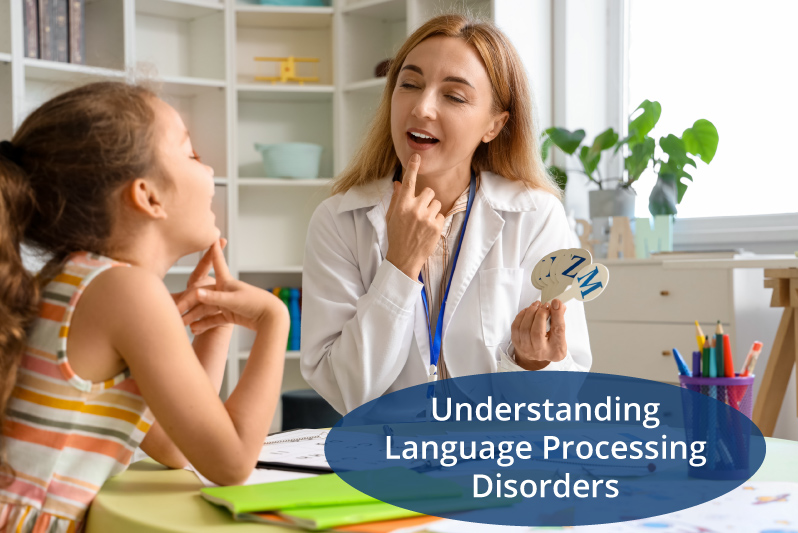
Language processing disorders are communication challenges that interfere with an individual’s ability to understand and use language effectively. As part of a broader range of speech and language processing difficulties, these disorders can impact comprehension, expression, and following directions. People with language processing disorders often struggle to participate fully in conversations or to grasp written text. Recognizing the nature of these challenges is essential for improving communication skills. At Lindamood-Bell, we are committed to providing personalized support and evidence-based instruction that helps learners reach their full potential. With extensive experience working with individuals diagnosed with language processing disorders, we tailor our instruction to meet each learner’s unique needs.
What Is Language Processing?
Language processing is a cognitive act, referring to the brain’s ability to interpret, understand, and produce language. As renowned cognitive psychologist, Dr. Allan Paivio explained, thinking involves the activity of two distinct cognitive subsystems, a theory he termed Dual Coding Theory. Dual Coding Theory proposes that human cognition utilizes two distinct systems for processing language: a verbal system (imagery) and a nonverbal system (imagery). The interplay of verbal and nonverbal information enhances comprehension, problem-solving, critical thinking, and all learning outcomes.
Language processing disorders disrupt these systems, resulting in challenges with understanding language, following complex instructions, and expressing thoughts clearly.
It’s important to distinguish language processing disorders from other communication challenges, such as speech articulation issues or social communication disorders. While those may involve difficulties with sound production or social interaction, language processing disorders affect a person’s ability to understand and use spoken or written language. Typical symptoms of language processing disorder include trouble with multi-step instructions, misinterpretation of verbal or written information, and difficulties with vocabulary and grammar.
A common myth is that language processing disorders result from limited language exposure, suggesting that children will simply ‘outgrow’ them. In reality, these are neurological conditions that typically require targeted intervention. Another widespread misconception is that language processing difficulties reflect low intelligence. In fact, many individuals with these challenges have average or above-average intelligence. Understanding these distinctions is essential for providing meaningful and effective support.
Types of Language Processing Disorders
Language processing disorders encompass a variety of challenges that can affect communication. The most prevalent types are expressive language disorder and receptive language disorder.
Expressive Language Disorder:
Expressive language disorder involves difficulty in verbal or written expression, often manifesting as limited vocabulary, sentence construction challenges, or trouble articulating thoughts. Individuals may have difficulty retrieving the right words, which can lead to frustration and negatively affect social interactions.
Receptive Language Disorder:
Receptive language disorder, by contrast, involves difficulty understanding and processing spoken language. Individuals may struggle to follow directions, comprehend questions, or interpret the meaning of conversations. These challenges can impact academic performance and social interaction, as understanding language is essential for effective communication and learning.
At Lindamood-Bell, we develop language comprehension through intensive, one-to-one instruction that builds the foundational sensory-cognitive skills vital for understanding and expression. The Visualizing and Verbalizing® program develops concept imagery—the ability to create mental representations from oral and written language—which is necessary for comprehension and critical thinking.
Central Auditory Processing Disorder (CAPD):
Additionally, central auditory processing disorder (CAPD) is closely related to language processing disorder. CAPD affects how the brain processes auditory information, making it difficult for an individual to distinguish and manipulate sounds, skills that are foundational to reading. This can lead to struggles with phonemic awareness, decoding, and fluency.
At Lindamood-Bell, we address reading challenges like these through intensive, one-to-one instruction that develops the sensory-cognitive skills essential for reading success. The Seeing Stars® program helps students with CAPD strengthen their ability to perceive sounds, decode words, and become more accurate and fluent readers.
Many students diagnosed with CAPD have made significant gains through our approach—see their progress here.
Although CAPD primarily affects sound interpretation, it can also impact language comprehension and expression. Individuals with CAPD may struggle to distinguish between similar-sounding words or follow spoken instructions, leading to difficulties in receptive and expressive language.
Understanding these types of language processing problems is essential for identifying specific needs and providing appropriate support. Lindamood-Bell offers tailored instruction to address many of these challenges.
Identifying Symptoms of Language Processing Disorders
Language processing disorders can manifest in various ways, affecting children and adults. Common signs include difficulty understanding spoken language, trouble following directions, and challenges with word retrieval. Children may struggle with vocabulary development and sentence construction, while adults might find it hard to participate in conversations or comprehend complex instructions.
The impact of language processing disorders on academic performance can be significant. Students often face challenges in reading comprehension, writing, and verbal communication. They may struggle to grasp text meanings or express thoughts clearly in written assignments, leading to frustration and decreased motivation in school settings.
Certain behaviors may also indicate a language processing disorder. For example, children might become frustrated or avoid talking altogether when asked to speak. Adults may shy away from situations that involve verbal communication, which can lead to social withdrawal. Recognizing these patterns early is essential for getting the proper support. Lindamood-Bell offers individualized instruction that builds language comprehension skills and improves academic performance, helping every student reach their full potential.
Support from Lindamood-Bell for Language Processing Disorders
Often, individuals diagnosed with language processing disorders have underlying weaknesses in concept imagery—the ability to create mental representations from oral and written language—and symbol imagery—the ability to auditorily perceive and mentally image the sounds and letters within words. At Lindamood-Bell, our personalized instruction is designed to address these underlying weaknesses directly, helping students develop the foundational skills they need to understand and express language with confidence, both in school and in life.
We use evidence-based programs that address the sensory-cognitive skills essential for reading and comprehension. Our instruction has been proven to improve outcomes for individuals with language and speech processing difficulties. Through targeted instruction and individualized support, students strengthen their ability to process language, which leads to better comprehension, communication, and overall learning success. Our instructional team delivers personalized, one-to-one support using proven strategies that empower each student to thrive.
A powerful example of this success is Andrew’s story. Andrew faced daily struggles with schoolwork and following directions related to his central auditory processing disorder. His mother turned to Lindamood-Bell for help, and everything changed. With our sensory-cognitive instruction, Andrew improved his oral and written language comprehension, using mental imagery to support understanding. Today, he’s thriving in school and beyond.
Watch Andrew’s story here: A Student with CAPD Thrives at School
If you are seeking support for a language processing disorder, we’re here to help. Contact us to learn how our individualized instruction can make a meaningful difference.
To get started, get in touch or call (800) 300-1818
 ×
×