


post
BLOG AND NEWS

Why Intensive Instruction Now?

Sep 29, 2017


A bright and articulate third grader, Jacob shifts uncomfortably in his seat when his teacher announces that they’d be taking turns reading aloud. “Maybe if I ask to go to the bathroom, I’ll miss my turn,” he thinks.


Jacob has a high vocabulary and his teachers frequently tell him how smart he is, but he’s beginning to doubt them. “How smart can I be if I can’t even read?” he asks himself. In the mornings he gets a stomach ache thinking about facing the school day. When he opens a book, “was” turns into “saw” and “through” and “though” and “thought” never sound like they’re supposed to. How is a person supposed to remember all of that?


Mrs. Jones calls on Emma, who always seems to be a step behind in class, and tells her to read from Chapter 2. “What?” Emma asks. She twists the ends of her blonde ringlets as she waits for Mrs. Jones to repeat her request. It’s not that she doesn’t care or isn’t listening in the classroom — but  directions still seem to go in one ear and out the other. Emma reads the page quickly and accurately but falls silent when Mrs. Jones asks her what she thinks will happen next in the story.


For Jacob, reading is the hardest thing in the world, and no one seems to know why. His teachers and parents thought eventually it would just “click” on its own. But students with a weakness in symbol imagery, or the ability to visualize letters and sounds within words, may require remediation or additional explicit reading instruction. Weak symbol imagery will cause difficulty in establishing sight words, contextual fluency, and spelling.


A few seats over, Emma is able to spell perfectly and decode new words with ease, but she doesn’t seem to comprehend what she’s read. When someone tells a joke, she quickly scans the room and notices other people are laughing, so she laughs too. For Emma, weak concept imagery—the ability to image a gestalt (whole)—may be the cause of her struggles. Weakness in concept imagery will interfere with reading and listening comprehension, memory, oral vocabulary, critical thinking, and writing.


As the critical third grade year continues, Jacob and Emma are likely to fall further and further behind. They may be present in class every day, but they’re both missing out on content and their self-esteem continues to quietly plummet.


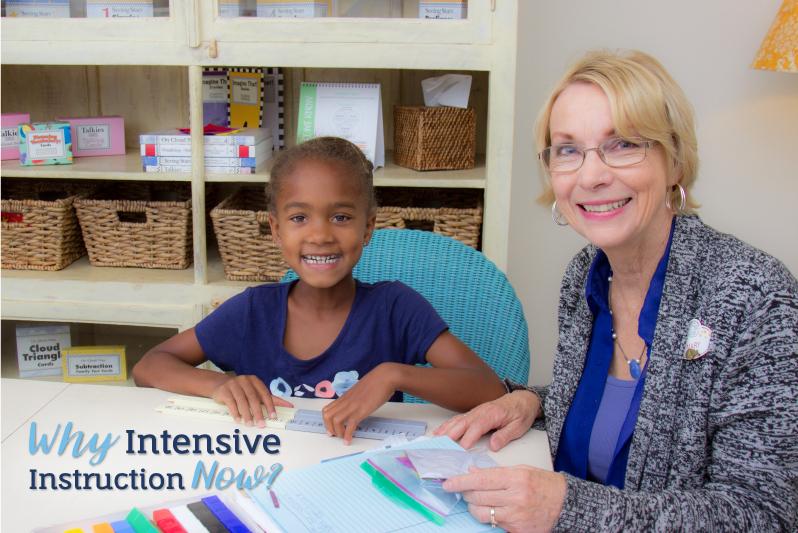
At Lindamood-Bell, we believe that all students can be taught to read and comprehend to their potential. We identify strengths and weaknesses that may be affecting school performance, and our instruction is based on an individual’s learning needs. The school year is a great time to address those learning needs — helping your child develop the underlying foundational skills for reading and comprehension will ensure that they don’t start to miss curriculum-based content because they’re unable to decode or comprehend it. For a student who has fallen behind, the way to close the gap is often intensive instruction. Click here to learn more about how we’re able to make years of gains in weeks of instruction.


We want to be your partner in education and help make your child’s school year a success. To learn more, contact your local Learning Center.

Connect with us
🎉 40 Years of Changing Lives Through Learning

🧠 2011: Georgetown University researchers publish a study showing changes in the brains of children with dyslexia following reading intervention.

Our next milestone highlights research conducted by Georgetown University's Center for the Study of Learning in collaboration with Lindamood-Bell.

Published in the scientific journal NeuroImage, the study followed children with dyslexia who received eight weeks of instruction using the Seeing Stars® program.

Researchers found significant improvements in reading skills, along with measurable increases in gray matter volume in the brain. Follow-up testing eight weeks later showed that these gains were maintained.

These findings offered encouraging evidence that effective reading instruction can help children with dyslexia improve their reading skills while also supporting changes in the brain.

Follow along as we celebrate 40 years of changing lives through learning!
🎉 40 Years of Changing Lives Through Learning

📖 Our next milestone takes us to 2010, when Nanci Bell published the Symbol Imagery (SI) Test.

This standardized assessment measures a student's ability to visualize the sounds and letters within words, an important skill for reading and spelling.

The SI Test helps educators identify and monitor skills that underlie word recognition, spelling, and reading fluency.

Follow along as we celebrate 40 years of changing lives through learning!
🐱 Calling all cat lovers! Celebrate National Cat Day with a FREE reading resource for parents and teachers, courtesy of Gander Publishing!

This Imagine That! lesson packet features five cat-themed stories for grades 2–6, vocabulary practice, puzzles, and a coloring page!

Perfect for use with Visualizing and Verbalizing® or with any student who could benefit from extra comprehension practice.

Download your free packet - follow the link in our bio, @lindamoodbellofficial!
🎉 40 Years of Changing Lives Through Learning

Our next milestone takes us to 2008, when Lindamood-Bell co-founder Nanci Bell was recognized by the California State Assembly as one of the state's Top 50 Women Business Leaders!

Follow along as we celebrate 40 years of changing lives through learning.
#LindamoodBell40 #LindamoodBell
🎧 New Podcast Episode!

How can art help students share their stories and make a difference in their communities?

Muralist Kyle Holbrook joins Lindamood-Bell for Schools Director of Development Dave Kiyvyra to discuss the Moving Lives of Kids Community Mural Project and the power of art to bring people together.

Hear how students are using creativity to express themselves and contribute to their communities.

Listen and subscribe at the link in our bio, @lindamoodbellofficial.
🎉 40 Years of Changing Lives Through Learning

📚 2006: What happens when an entire school district works to improve reading?

In 2006, researchers from Texas A&M University published a study in the American Educational Research Journal examining reading achievement in Colorado’s Pueblo School District 60, where Lindamood-Bell had been working with schools since 1997 to support students at risk of reading difficulties.

They examined reading scores for students in grades 3–5 over several years and found that schools using Lindamood-Bell instruction made significantly greater gains than schools across Colorado. Those gains increased over time, including in Title I schools.

It was encouraging to see these results, especially in a district where so many students needed additional reading support.

Follow along as we celebrate 40 years of changing lives through learning.

Tap the link in our bio, @lindamoodbellofficial,  to learn more about our work and research.
📣 FREE Halloween Download for Parents and Teachers, courtesy of Gander Publishing! 🎃
The Imagine That! Halloween lesson packet features four high-imagery stories written at a 2nd–5th-grade reading level.

👻 Enjoy stories about a giant pumpkin, a ghost, and even a rooster accused of being a witch!
🎃 Build reading comprehension with higher-order thinking questions.
🍬 Strengthen vocabulary skills with engaging activities.

Perfect for use with Visualizing and Verbalizing® or any student who could benefit from extra comprehension practice.
Download your free packet and bring some Halloween fun to reading! Follow the link in our bio, @lindamoodbellofficial
🎉 40 Years of Changing Lives Through Learning

🧠 2004: Georgetown University researchers publish an important study on adult dyslexia and Lindamood-Bell instruction.

Led by Dr. Guinevere Eden and published in the scientific journal Neuron, the study used brain imaging to examine changes in adults with dyslexia following eight weeks of intensive Lindamood-Bell instruction.

Researchers found improvements in reading skills along with changes in brain activity, showing that the adult brain can continue to change and develop with reading instruction.

More than 20 years later, these findings continue to offer hope for adults who struggle with reading.

For more about our evidence-based reading instruction, follow the link in our bio, @lindamoodbellofficial.

Follow along as we celebrate 40 years of changing lives through learning!
🎉 40 Years of Changing Lives Through Learning

Our next milestone takes us to 2002, when Lindamood-Bell reached another exciting first!

🇬🇧 2002: Our first international Learning Center opens in London, England.
The opening of our London Learning Center meant more children could benefit from individualized instruction to strengthen their reading and comprehension skills. It was another meaningful step in helping more students learn to their potential.

Follow along as we celebrate 40 years of changing lives through learning.

Explore Lindamood-Bell at the link in our bio, @lindamoodbellofficial.
🎙️ New Podcast Episode: Supporting At-Promise Students

In this episode, we’re joined by Khieem Jackson, Managing Director of Reaching At-Promise Students Association (RAPSA), for a thoughtful conversation about helping at-promise and opportunity youth thrive.
Together, we explore how the words we use to describe students can shape their experiences, and how literacy and learning can open doors to new opportunities beyond the classroom.

🎧 Listen and subscribe at the link in our bio, @lindamoodbellofficial.
Lindamood-Bell will be at the International Dyslexia Association 2026 Annual Reading, Literacy & Learning Conference, November 12–14 in Las Vegas.

Join Paul Worthington, Director of Research and Development, for “ADHD and Dyslexia: Untangling the Comorbidity Conundrum,” which examines research on co-occurring ADHD, dyslexia, and language-processing difficulties, as well as implications for intervention.

📅 November 12–14
📍 Las Vegas + virtual attendance available

Learn more about our presentation and where to find us at the conference at the link in our bio, @lindamoodbellofficial.
🎉 40 Years of Changing Lives Through Learning

📚 2000: Lindamood-Bell partners with juvenile justice schools in San Diego, California, for Project of Hope.

Through this partnership, Lindamood-Bell provided intensive reading and comprehension instruction to young people in the juvenile justice system.
Using the Seeing Stars® and Visualizing and Verbalizing® programs, Project of Hope helped students strengthen their reading and comprehension skills. An independent evaluation found significant gains, offering new hope and opportunities for their futures.

Follow along as we celebrate 40 years of changing lives through learning. 

Explore Lindamood-Bell at the link in our bio, @lindamoodbellofficial
Students with ADHD may need more than help with organization and study skills.

Our latest blog explores how individualized instruction can help students strengthen underlying learning skills, manage schoolwork, and become more confident, independent learners.

👉 Learn more at the link in our bio, @lindamoodbellofficial.
Request Information

Request Information

When you complete our form, we'll send you to our digital information packet and reach out to you shortly.
You may also call us at

Schedule a Learning
Ability Evaluation

Please fill out the form and we will be in touch to schedule an evaluation.