




What Is Dual Coding Theory? Strengthening Reading and Comprehension
At Lindamood-Bell, our approach is grounded in Dual Coding Theory (DCT), a cognitive framework that demonstrates how the brain processes information. Developed by cognitive psychologist Allan Paivio, DCT posits that humans have both verbal and nonverbal systems for processing information.
- Verbal: Words, symbols, letters, phonemes, grammar, definitions, and mathematical notation.
- Nonverbal: Mental images, scenes, diagrams, timelines, and sensory details like size, color, and movement.
Frequently Asked Questions About Dual Coding Theory
What is Dual Coding Theory?
DCT is a theory of mind that explains how the brain processes information using both verbal and visual systems simultaneously. Words paired with imagery create richer, more durable mental representations that improve comprehension, recall, and application of knowledge. Lindamood-Bell’s sensory-cognitive instruction applies these principles by strengthening concept imagery for comprehension as well as symbol imagery for reading and spelling.
Is Dual Coding Theory the same as “learning styles”?
No. DCT does not categorize learners as either visual or verbal. Instead, it shows that all learners benefit from integrating both imagery and language.
How does Dual Coding Theory support struggling readers?
Many struggling readers can decode but cannot form a unified mental image of the text. DCT-aligned instruction helps students build imagery for oral and written language, improving comprehension, memory, and critical thinking. Strengthening symbol imagery improves decoding accuracy, orthographic mapping, and spelling.
Dual Coding Theory: The Imagery-Language Connection in Literacy
The following section is excerpted from Visualizing and Verbalizing® for Language Comprehension and Thinking, V/V® Teacher’s Manual, Second Edition (2007) by Nanci Bell:
“Language comprehension is the ability to connect to and interpret meaning for both oral and written language. It includes the ability to recall facts, get the main idea, infer, conclude, predict, and evaluate. Language comprehension is a cognitive act. Instruction in comprehension must align with a theory of cognition.
“The Visualizing and Verbalizing program (V/V) emerged from an experiential base, not a theoretical base. Years of experience teaching students to comprehend oral and written language eventually led to the sequential steps of V/V, a program specifically designed to develop language comprehension and thinking. In time, I learned that the principles of the Visualizing and Verbalizing program align with one of the most prominent theories in cognitive psychology—Dual Coding Theory.
“Allan Paivio, a cognitive psychologist, researcher, and the originator of Dual Coding Theory, has written extensively about the role of imagery in cognition. Paivio (2006) explains that ‘As its name suggests, the theory is based on the assumption that thinking involves the activity of two distinct cognitive subsystems, a verbal system specialized for dealing directly with language and a nonverbal system specialized for dealing with nonlinguistic objects and events.’
“Paivio and Mark Sadoski (2001) specifically connect Dual Coding Theory to language processing for reading:
Dual Coding Theory is the general theory of cognition that provides our unifying framework for literacy. This theory offers a comprehensive account of both verbal and nonverbal cognition. The inclusion of nonverbal aspects of cognition, such as mental imagery, is the most novel facet of this approach in a modern context, but it provides a comprehensive account of the verbal, linguistic aspects of cognition as well. Accordingly, it provides an explicit psychological account of literacy’s most central but elusive ingredient: meaning.
“Sadoski (2006) simplifies the theory: ‘Dual coding theory is a theory of mind in which all cognition consists of the independent activity of, or interplay between, two great mental codes: a verbal code specialized for language and a nonverbal code specialized for knowledge of the world in the form of mental images.’ The theory that more than just a single, verbal code is needed for language comprehension is consistent with my numerous years of experience teaching students to comprehend and interpret language. Without the sensory information of imagery, words have no meaning, neither individually nor connected together to form concepts. The single code of language cannot do the job alone. Imagery plays a role in both concrete and abstract language comprehension.
“Both codes are based on a substrate of imagery, or mental representations. DCT is distinctive from other theories of reading in that processing – activation of memory for decoding sounds and letters or getting meaning from language – can occur between two sensory modalities (verbal and nonverbal), whereas other theories of reading account for one modality (verbal), including reading models for phonics, morphology, and syntactic/semantic artifacts of literacy.
“Clinical research and experience over the last twenty-five years indicate that there is a language comprehension disorder that, unfortunately, is rarely identified. This separate comprehension weakness often undermines the reading process and goes beyond the use of context, phonological processing, word recognition, oral vocabulary, prior knowledge, and background experience. It is a weakness based in the sensory system in creating an imaged gestalt.”
Instruction Aligned With Dual Coding Theory
Reading is both an academic skill and a cognitive process. Effective instruction aligns with how the brain processes language and imagery, and Dual Coding Theory supports the growth of strong readers. Three sensory-cognitive functions underlie reading and comprehension.
- Phoneme Awareness is the ability to perceive the identity, number, and sequence of sounds within words.
- Symbol imagery is the ability to create mental imagery for sounds and letters within words.
- Concept imagery is the ability to image a gestalt (whole) for oral and written language.
While individuals may have differences in their abilities, the processes needed for reading are not different. Sensory-cognitive functions can be developed, and this change can improve an individual’s ability to read and comprehend. Reading is a cognitive act that involves both language and imagery. Effective literacy Instruction aligns with a theory of cognition.
Peer-Reviewed Research on Dual Coding Theory and Lindamood-Bell Instruction
Lindamood-Bell regularly collaborates with research institutions to study the efficacy of our approach. In a study conducted by Texas A&M researchers, Lindamood-Bell partnered with Pueblo District 60 in Pueblo, Colorado, to implement an initiative based on a theory of cognition to improve Colorado Student Assessment Program reading scores.
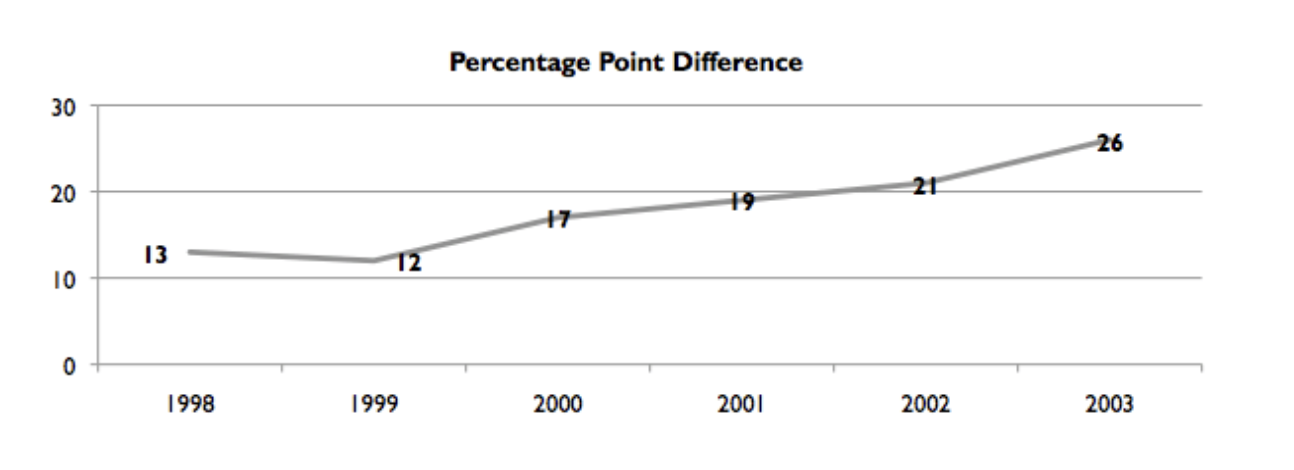
Students received Seeing Stars, Visualizing and Verbalizing, and Lindamood Phoneme Sequencing instruction to develop symbol imagery, concept imagery, and phonemic awareness. This study investigated the effect of dual coding theory using the Seeing Stars and Visualizing and Verbalizing programs. Instruction was delivered by Pueblo City Schools teachers trained in the programs. Student gains were measured with the state reading test. The results were compared to gains made by students from other, similar schools in Colorado who did not receive Lindamood-Bell instruction. Schools were comparable due to controlling for school size, free and reduced-price lunch, and minority populations. Third-grade results for Title I schools are provided below.
Results
The line in the chart above shows the percentage point difference (in percent proficient and advanced on the state reading test) between Pueblo (Lindamood-Bell) schools and comparison schools. By 2003, schools partnering with Lindamood-Bell were 26 percentage points above the average of the comparison schools. The independent evaluators who conducted this research determined that the main effect of Lindamood-Bell instruction was statistically significant (p < .0001). In their published article, they state that “[Pueblo] Title I schools outperformed the average of the remaining comparable Title I schools in the state in an increasingly positive way during the years 1998-2003.” The results of this study support the dual coding theory model of cognition and illustrate that Lindamood-Bell instruction in the Seeing Stars, Visualizing and Verbalizing, and Lindamood Phoneme Sequencing programs lead to improved reading, which is essential to achieving success with school curricula.
Access the full article, “Effects of a Theoretically Based Large-Scale Reading Intervention in a Multicultural Urban School District,” published in the American Educational Research Journal.
Applying Dual Coding Theory: Support for Educators
Our founders’ programs demonstrate how dual coding theory can be applied to teaching. We help students develop symbol imagery, concept imagery, and phonemic awareness, turning theory into measurable results.
For Struggling Readers
- Seeing Stars (SI): Symbol imagery for reading, spelling, phonological processing, and orthographic mapping.
- Lindamood Phoneme Sequencing (LiPS): Phonemic awareness through multisensory sequencing and articulatory feedback.
For Students with Comprehension Challenges
- Visualizing and Verbalizing (VV): Concept imagery for comprehension, reasoning, memory, and critical thinking.
Talkies: Early oral language development with concept imagery routines.
We invite educators and school administrators to explore how instruction grounded in a theory of cognition can transform literacy outcomes. Discover our teacher workshops and contact us at pd.solutions@lindamoodbell.com to learn more and get started.
 ×
×