



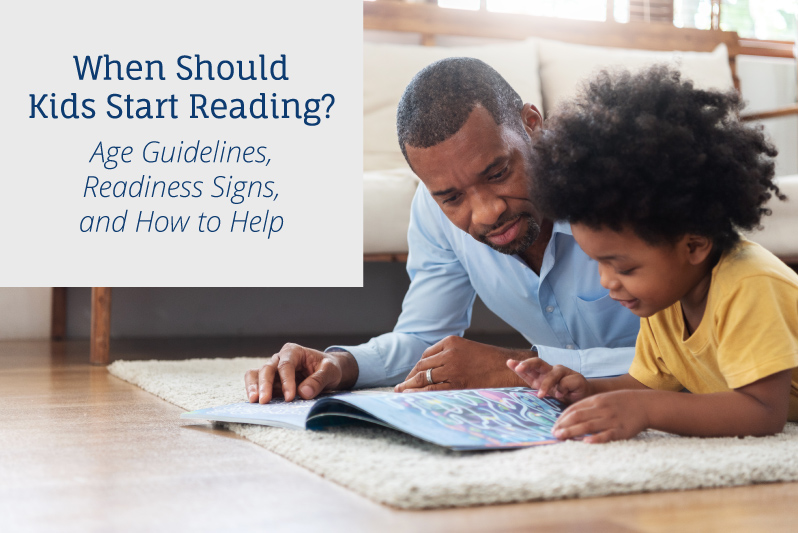
When Should Kids Start Reading? Age Guidelines, Readiness Signs, and How to Help
In this guide, we’ll explore typical reading milestones, signs of reading readiness, and ways families and educators can support reading development while drawing on Lindamood-Bell’s decades of experience developing the sensory-cognitive skills that underlie literacy.
Key Takeaways
- Many children begin learning to read during kindergarten and first grade, with fluency and comprehension continuing to develop throughout the early elementary years.
- Interest in books, letter-sound knowledge, helps prepare children to become successful readers.
- Children benefit from daily read-alouds, rich conversation, explicit, systematic instruction, and opportunities to develop the sensory-cognitive skills that support reading and comprehension.
- If progress slows or reading becomes frustrating, a comprehensive learning evaluation can identify underlying skill needs and guide individualized instruction.
Typical Reading Milestones by Age

Infants and Toddlers (Birth to Age 3):
The earliest foundations for reading develop long before children recognize letters or words. Babies enjoy being read to, learn that books are meaningful, and begin connecting spoken language with pictures and experiences.
As toddlers grow, they may begin pointing to pictures, turning pages, naming familiar objects, and participating in simple stories. These early experiences lay the groundwork for future reading success.
Preschool and Kindergarten (Ages 3–5):
During the preschool years, children may begin to recognize letters, especially those in their own names.
Children also learn important print concepts, such as holding books correctly, following text from left to right, and understanding that written words represent spoken language.
As kindergarten progresses, children may begin connecting letters to sounds, blending simple sounds, and reading basic decodable words such as cat and map.
Early Elementary (Ages 6-8):
During first and second grade, most children expand their decoding skills to longer words, recognize an increasing number of high-frequency words, and read with greater accuracy and fluency.
At the same time, vocabulary and language comprehension continue to grow. Children become better at retelling stories, answering questions, making predictions, and drawing simple conclusions from what they read.
While these milestones are common, some children may reach them earlier and other children may not reach these milestones by early elementary ages. Others benefit from additional support to develop the underlying skills that make reading easier. From this point, students need explicit instruction to be proficient readers.
Signs a Child Is Ready to Learn to Read

In the early years, look for signs that your child is developing the skills needed for successful reading.
Interest in Books and Print
Children who are becoming ready to read often:
- Ask to be read to frequently
- Pretend to read favorite books
- Point to words or pictures while listening
- Notice letters on signs, packaging, or clothing
- Recognize letters in their own name
These behaviors show growing curiosity about how written language works.
Foundational Reading Skills
Children preparing to read may be developing important foundational abilities, including:
- Phonemic awareness, the ability to auditorily perceive and mentally image the sounds and letters within words
- Letter-sound knowledge, connecting common letters with their corresponding sounds
- Print awareness, understanding where reading begins on a page, and that print carries meaning
- Concept imagery, the ability to create an imaged gestalt (whole) from oral and written language
- Symbol imagery, creating mental representations of letters and words that support accurate decoding and spelling
These skills provide the foundation for reading words accurately and efficiently.
When to Consider an Evaluation
Children develop at different rates, but it may be helpful to seek additional support if your child:
- Has difficulty remembering letter names and sounds after repeated exposure
- Struggles to hear or manipulate sounds in words
- Frequently guesses at words instead of sounding them out
- Avoids reading because it feels frustrating
- Reads words accurately but has difficulty remembering or explaining what was read
- Continues to struggle with decoding or fluency beyond early first grade
A comprehensive Learning Ability Evaluation identifies a student’s strengths and weaknesses that may affect performance in reading, comprehension, and math.
How Parents and Teachers Can Support Early Reading

Everyday Reading and Conversation
Reading aloud every day remains one of the most effective ways to support literacy development. However, reading aloud doesn’t teach decoding and phonics skills, which are essential for learning to reading independently. It’s a powerful complement to systematic phonics instruction, not a substitute for it.
As you read together:
- Pause to discuss book illustrations.
- Ask what your child thinks might happen next.
- Encourage them to describe favorite characters or events.
- Introduce new vocabulary during.
Children often show growing comprehension when they begin predicting story events, remembering details, or making connections between stories and their own lives.
Explicit, Systematic Instruction
Children benefit from explicit, systematic instruction that clearly connects sounds, letters, and words while developing the sensory-cognitive skills that support reading. Activities that develop symbol imagery help children create mental representations of letters and words for accurate decoding, fluent reading, and spelling.
To strengthen comprehension, encourage children to create mental images as they listen and read, discuss story structure, preview unfamiliar vocabulary, and talk about characters’ actions and ideas. Developing concept imagery supports understanding, memory, and higher-order thinking.
Environment and Interest
Provide books that match your child’s interests and current reading level, and make reading an enjoyable part of daily life. Allow children to choose books that excite them. Positive reading experiences help build confidence and encourage children to see themselves as capable readers.
What to Do If Reading Is Delayed or Challenging

Every child learns at a different pace, and occasional struggles are a normal part of learning. However, persistent reading difficulties may indicate that a child needs additional support to develop the underlying skills that make reading successful.
Common Signs of Reading Difficulty
A family history of reading difficulties may also increase the likelihood that a child will benefit from additional support.
Evidence-Based Intervention
The most effective intervention begins with understanding why a child is struggling.
A comprehensive learning ability evaluation can identify strengths and needs in areas such as phonemic awareness, symbol imagery, decoding, fluency, vocabulary, language comprehension, and concept imagery. This information provides a clear picture of the sensory-cognitive processes affecting reading development and helps guide individualized instruction.
Effective intervention is explicit, systematic, and matched to each student’s learning needs. Rather than simply increasing practice, instruction should develop the underlying sensory-cognitive skills that support lasting improvements in reading.
At Lindamood-Bell, instruction focuses on developing phonemic awareness, symbol imagery, and concept imagery to strengthen word recognition, spelling, reading fluency, vocabulary, and language comprehension.
Schools and Specialists
Regular communication with classroom teachers, reading specialists, and other professionals helps ensure that instruction is aligned with each child’s needs. Ask about the instructional program being used, instructional goals, how progress will be measured, and how skills can be reinforced at home.
As students grow, their progress should be monitored regularly so instruction can be adjusted to their individual needs.
Quick Reference: Reading Readiness and Support
| Age/Stage | What You Might See | How to Help |
| Birth–3 | Interest in books, pointing to pictures, naming familiar objects
|
Read and sing every day, talk during routines, introduce new vocabulary, encourage conversation |
| Ages 3–5 | Letter recognition, rhyming, noticing beginning sounds, interest in print
|
Play sound games, connect letters to sounds, read together daily, encourage storytelling |
| Ages 6-8 | Decoding longer words, growing fluency, increasing comprehension
|
Provide explicit, systematic reading instruction, develop symbol imagery, preview vocabulary, discuss stories, encourage mental imagery while reading |
| Anytime concerns arise | Difficulty with sounds, guessing at words, slow reading, frustration, weak comprehension
|
Schedule a comprehensive Learning Ability Evaluation and provide individualized instruction that develops phonemic awareness, symbol imagery, and concept imagery |
Bottom Line: When Should Kids Start Reading?

Most children begin learning to read during kindergarten and first grade, but readiness varies from child to child. Rather than focusing on a specific birthday or comparing your child with classmates, pay attention to the foundational skills that support reading, including curiosity about books, awareness of sounds in words, and growing letter-sound knowledge. Further, if your child shows frustration, avoidance, or a drop in confidence around reading tasks, that’s worth paying attention to, as it can be a sign they need additional support.
Support reading development through daily read-alouds, rich conversation, and explicit, systematic instruction that develops the sensory-cognitive skills underlying reading. Strong symbol imagery supports accurate word recognition, spelling, and fluent reading, while concept imagery strengthens language comprehension, memory, and critical thinking.
If progress slows or reading becomes consistently frustrating, it is important to understand the underlying cause rather than simply increasing practice. A Learning Ability Evaluation can identify the sensory-cognitive skills affecting reading development and provide a clear, individualized plan for instruction.
Lindamood-Bell’s evidence-based instruction develops the sensory-cognitive skills that support reading, comprehension, and learning. Programs such as Seeing Stars® develop symbol imagery for accurate decoding, spelling, and fluent reading, while Visualizing and Verbalizing® develops concept imagery for language comprehension and higher-order thinking. By strengthening these foundational skills, students build the confidence and abilities they need to become capable, engaged readers.
If you have concerns about your child’s reading development, contact Lindamood-Bell to learn more about a Learning Ability Evaluation and individualized instruction.
 ×
×