




Dyslexia Causes and Interventions | Explore the Facts and Find Support
Understanding the causes of dyslexia helps parents and educators make informed decisions about effective, evidence-based support.
What Is Dyslexia?

Dyslexia is a specific learning disability characterized by difficulties in word reading and/or spelling that involve accuracy, speed, or both and vary depending on the orthography of the English language. These difficulties occur along a continuum of severity and may persist even with instruction that is effective for the individual’s peers. The causes of dyslexia are complex and involve combinations of genetic, neurobiological, and environmental influences that interact throughout development. Underlying difficulties with phonological, orthographic, and morphological processing are common but not universal, and early oral language weaknesses often foreshadow literacy challenges. Secondary consequences include reading comprehension problems and reduced reading and writing experience, which can impede growth in language, knowledge, written expression, and overall academic achievement. Psychological well-being and employment opportunities also may be affected. Although identification and targeted instruction are important at any age, language and literacy support before and during the early years of education is particularly effective. Targeted instruction beyond the early years of education, when diagnostically driven and delivered intensively, can lead to remediation of dyslexia.
What Are the Possible Causes of Dyslexia?

The Brain’s Reading Network
Understanding what causes dyslexia begins with understanding the brain’s reading network. Reading relies on interconnected regions in the left hemisphere that support the processing of the sounds of the phonemes in the English language, coupled with the symbols/letters representing those sounds, and their relationships to words. Difficulties grounded in these brain-based regions negatively affect word recognition. In dyslexia, these neurological systems do not activate as efficiently, and the connections among them differ from those of typical readers. These differences are present early in development and are not the result of low intelligence. Causation is complex. Beyond genetic factors, the lack of evidence-based developmental instruction in appropriate educational environments that address the necessary brain processes may contribute to a diagnosis of dyslexia.
Specifically, from what is termed as a sensory-cognitive perspective, instructionally stimulating and systematically addressing the combination of phonological and orthographic processing (sounds and letter symbols) as applied to words plays a central role in learning to read. When the brain has difficulty precisely perceiving, segmenting, and manipulating speech sounds in combination with letters, it may struggle to build stable connections as applied to decoding (reading) and encoding (spelling).
The encouraging news is that research indicates that, with effective, structured sensory-cognitive instruction that directly targets these underlying processes, neural pathways connecting the auditory, visual, and language systems can and will become more efficient over time, with the right instruction over the necessary amount of time. Research from the Universities of Georgetown, the University of Washington, MIT and Stanford has shown that targeted reading intervention can support measurable changes in the brain’s reading circuitry alongside behavioral improvements in reading skills. Learn more in the article, Teachers are Brain Engineers, from the University of Washington.
Genetic and Hereditary Factors of Dyslexia
As inferred from above, genetic influences are associated with reading development, though no single gene causes dyslexia. Instead, multiple genetic factors contribute to the development of the networks involved with all processes associated with learning to read.
Because these influences are complex, two individuals with similar family histories may have very different learning profiles. What remains consistent is that early identification and instruction that directly strengthen foundational reading skills can significantly improve outcomes.
Environmental Influences on Dyslexia
Environmental factors can significantly contribute to the diagnosis of dyslexia, influencing how early reading challenges are addressed if children do not receive effective, scientifically validated instructional support. From a sensory-cognitive perspective, in addition to early rich print exposure, specific diagnostic assessments play an important role in helping educators identify students who may need additional support.
When concerns are recognized early and timely, with the right kind of explicit instruction that directly develops underlying sensory-cognitive reading skills, stronger outcomes can be realized. High-quality early, scientifically based differential diagnosis and literacy instruction in preschool, kindergarten, and the primary grades can help identify difficulties sooner and provide students with targeted support before reading struggles become more significant. Not addressing these factors will affect whether students are identified and supported, determining the odds of a diagnosis of dyslexia.
When instruction does not explicitly target the necessary underlying sensory-cognitive skills, students may continue to struggle despite exposure and effort. In contrast, instruction that directly develops these foundational systems can lead to meaningful, measurable growth in reading and comprehension. Dyslexia occurs across all socioeconomic backgrounds, languages, and learning environments.
Myths and Misconceptions About Dyslexia
Myth: Dyslexia is associated with low intelligence.
Fact: Individuals with dyslexia have a wide range of intellectual abilities, often average to above average. Dyslexia affects reading efficiency, not thinking or learning capacity.
Myth: Dyslexia is caused by a phonological processing weakness.
Fact: While Phonological processing is a factor, there is more to it. The ability to process the orthographic structure (number, order, and sequence of letters in words) of English is equally at play in learning to read.
Myth: Students will outgrow dyslexia without help.
Fact: While individuals may develop coping strategies, dyslexia reflects underlying language-processing differences that benefit from explicit, structured instruction targeting foundational reading skills.
Myth: Dyslexia is lifelong and cannot be helped.
Fact: Research shows that appropriate intensive instruction can lead to significant improvement in reading and spelling for students with dyslexia. Early, intensive, and explicit instruction that develops underlying sensory-cognitive and language-processing skills is associated with stronger outcomes.
Myth: Accommodations are the primary way to help someone with dyslexia.
Fact: Accommodations such as extra time or audiobooks can improve access to grade-level content, but they do not directly develop the underlying reading skills needed for long-term independence. Students with dyslexia benefit most from explicit, systematic instruction that directly targets foundational sensory-cognitive skills, including phonological awareness and symbol imagery – the ability to create mental representations for letters and words. Strengthening these skills supports accurate word recognition and reading fluency over time.
How Dyslexia Is Identified

Early signs can appear before formal reading instruction, including difficulty with rhyming, recognizing and manipulating sounds, and learning letter names and sounds. These early indicators reflect developing phonological awareness skills.
As reading begins, consistent struggles with decoding, slow and effortful reading, and persistent spelling difficulties may indicate a need for evaluation.
A comprehensive assessment typically includes measures of phonological awareness, letter-sound knowledge, decoding, word reading, fluency, spelling, and language comprehension. These results help identify specific sensory-cognitive strengths and weaknesses and guide instruction that targets the underlying skills involved in what causes dyslexia.
Support for Dyslexia at Lindamood-Bell

At Lindamood-Bell, we help families attain real, measurable progress by focusing on the sensory-cognitive foundations of reading. Our instruction targets the underlying causes of reading weaknesses, including phonological processing and symbol imagery (orthographic processing) —the ability to create mental representations for sounds and letters—which supports accurate decoding and fluent reading.
We provide individualized, intensive instruction that strengthens the cognitive skills necessary for reading, including:
- Phonological awareness and symbol imagery
- Decoding and word recognition
- Spelling and written language
- Reading fluency and comprehension
We begin with a comprehensive Learning Ability Evaluation to identify each learner’s strengths and needs, then create a personalized instruction plan with clear goals and frequent progress checks. Families partner with our team to support sustained growth over time. Independent research and outcome data, including studies showing changes in brain pathways alongside gains in reading skills, position Lindamood-Bell as a trusted leader in literacy instruction.
For nearly four decades, Lindamood-Bell has worked with tens of thousands of individuals. Our success is grounded in our sensory-cognitive approach to instruction, which directly targets the skills underlying reading development.
The Seeing Stars® program develops symbol imagery, the ability to visualize letters in words. This skill supports decoding unfamiliar words, recognizing sight words, spelling, and fluent reading in context. See the progress results that students with dyslexia made after Lindamood-Bell instruction:
Students with a Prior Dyslexia Diagnosis Who Received Decoding Instruction Only
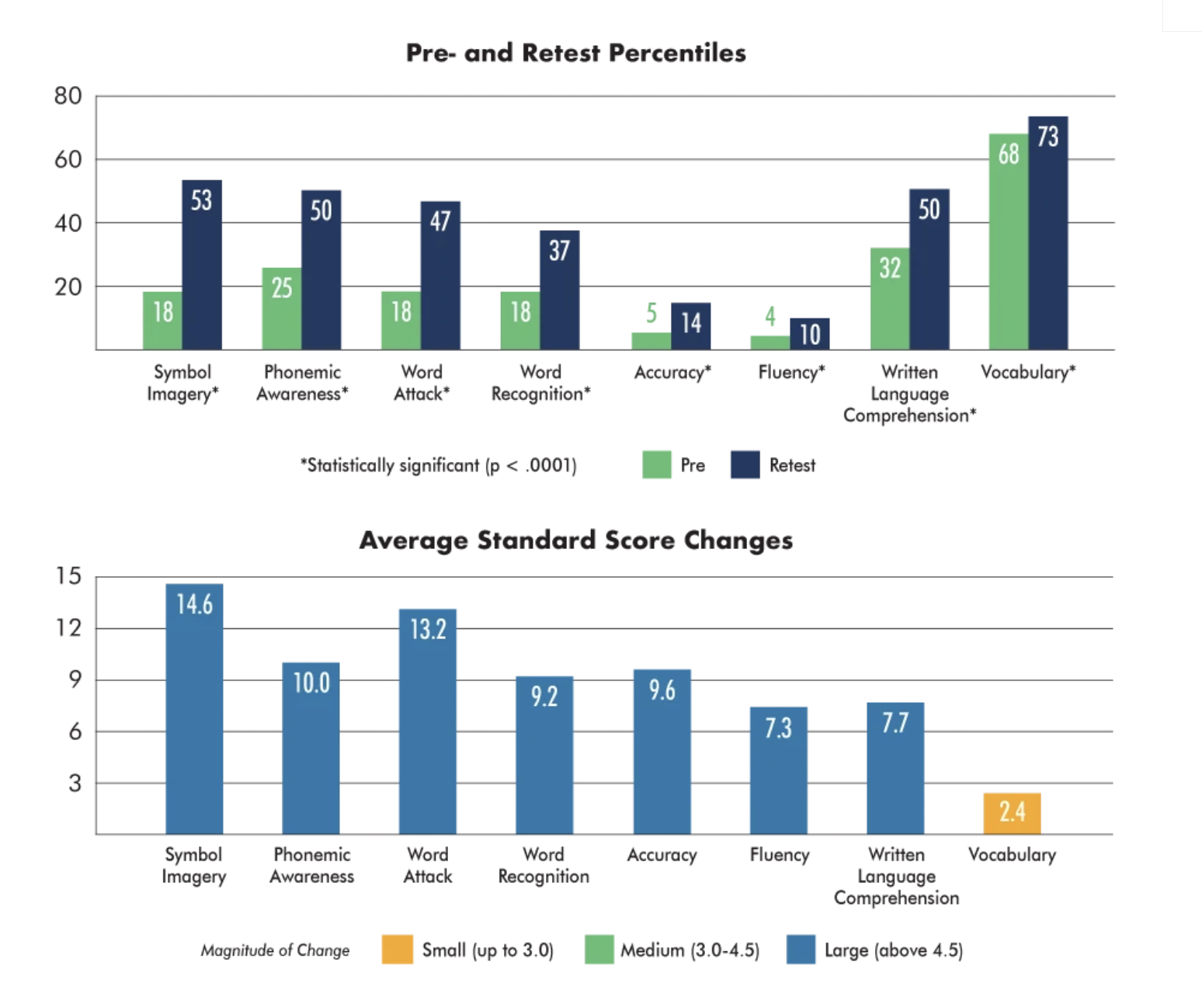
Lindamood-Bell Instruction Implemented: Seeing Stars
Years: Jan. 2008 – Dec. 2024
Number of Students: 3,605
Average Age: 10.2
Average Instruction Hours: 125.8
Take the Next Step

If you’re wondering how to support your child’s reading growth, we can help you move forward with clarity and confidence. For nearly forty years, Lindamood-Bell has partnered with families to transform reading and comprehension through instruction that targets the underlying causes of reading difficulty and builds strong, independent learners. Schedule a Learning Ability Evaluation to gain a clear understanding of your child’s strengths and needs and take the next step toward meaningful progress.
 ×
×