




Join Us at the International Dyslexia Association 2026 Annual Reading, Literacy & Learning Conference
Date:
November 12–14, 2026
Location:
Hyatt Grand Rio – Las Vegas, NV
3700 W Flamingo Rd
Las Vegas, NV 89103
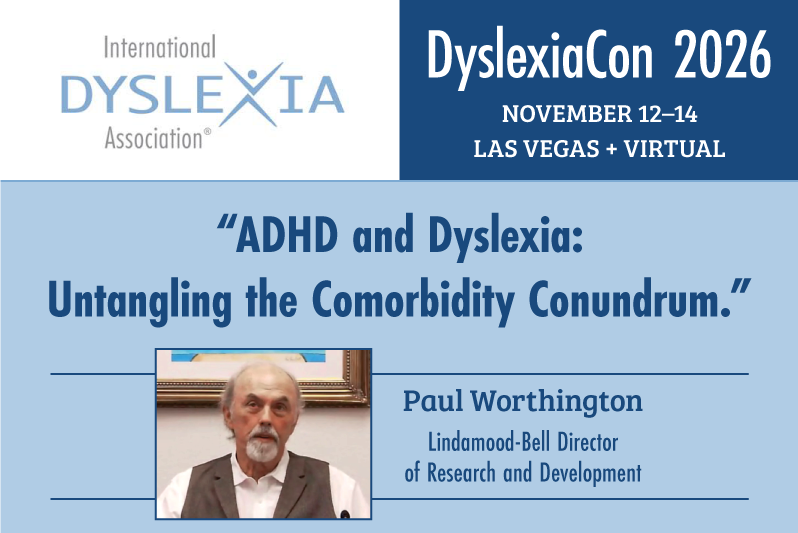
Attend our presentation, “ADHD and Dyslexia: Untangling the Comorbidity Conundrum” during DyslexiaCon 2026. If you are unable to attend in person, you may register for virtual attendance to watch and listen to our presentation.
Visit the Lindamood-Bell booth in the Exhibit Hall to connect with our team and learn more.
Title: ADHD and Dyslexia: Untangling the Comorbidity Conundrum
Presenter: Paul Worthington, Director of Research and Development, Lindamood-Bell
The co-occurrence of ADHD and cognitive and language-based learning disorders represents one of the most well-established and increasingly prevalent patterns in developmental neuroscience and educational epidemiology. ADHD frequently coexists with dyslexia, developmental language disorders, and written language impairments, reflecting the deeply interconnected nature of attention, working memory, language, and executive functioning systems. Current estimates indicate that approximately 35–45% of children with ADHD also meet criteria for a learning disability, while 25–40% of children with learning disabilities present with ADHD. Importantly, the prevalence of these overlapping conditions continues to rise, amplifying the need for precise diagnosis and effective intervention.
There are diagnostic and intervention complexities involved in supporting individuals with ADHD who also experience learning challenges. The presentation will review findings on the comparative incidence of these co-occurring difficulties, as well as the unique and shared characteristics of these complex learner profiles. A detailed analysis will be provided on the challenges associated with addressing dyslexia and language comprehension deficits in students with ADHD. As rates of both ADHD and learning disorders increase, so too does the complexity of co-occurring profiles, particularly those involving dyslexia and deficits in oral and written language comprehension. These layered challenges present significant obstacles for educators and clinicians, complicating both differential diagnosis and the implementation of targeted, evidence-based interventions. A critical question remains: how do learning profiles differ between individuals with ADHD alone and those with co-occurring learning disabilities, and what implications do these differences have for intervention design?
This presentation will address the multifaceted nature of these comorbid conditions, synthesize current research, and advance a clearer understanding of their diagnostic and instructional implications. Emphasis will be placed on what has been learned about effectively supporting students with ADHD who also demonstrate language and learning processing deficits. With a focus on remediation, the session will examine how to strategically determine intervention priorities when multiple domains—attention, language, and cognition—require simultaneous support.
Drawing on a large-scale analysis of 6,991 individuals diagnosed with ADHD, this presentation will highlight subgroup findings, including individuals with dyslexia (n = 2,700), language comprehension deficits (n = 1,481), and combined language processing impairments (n = 242). These data provide a robust foundation for examining distinct and overlapping profiles, informing both diagnostic clarity and the development of integrated, evidence-based intervention models.
 ×
×