



post
BLOG AND NEWS

Better Comprehension | Every Day Tips for Parents

Dec 21, 2017


When a child has an identified comprehension weakness, it makes sense to pursue extra help for academics. Students can get help from tutors, learning specialists, or may have an IEP (Individualised Education Plan) in place at school. Unfortunately, language comprehension troubles can affect family life, too. This is especially difficult when weak thinking skills are misconstrued as poor behavior. The child who “never listens” may not understand the task at hand.

A primary cause of language comprehension problems is difficulty creating mental images for language. This weakness causes individuals to get only “parts” of information they read or hear, but not the whole. This weakness often undermines the reading and thinking process. Students with weak language comprehension are commonly saddled with the misconception that they are just not trying, or, that they are distractible.  In fact, they may be trying very hard to memorise everything they have heard or read. And they need help.


Check out some examples of how concept imagery issues can affect school and home:
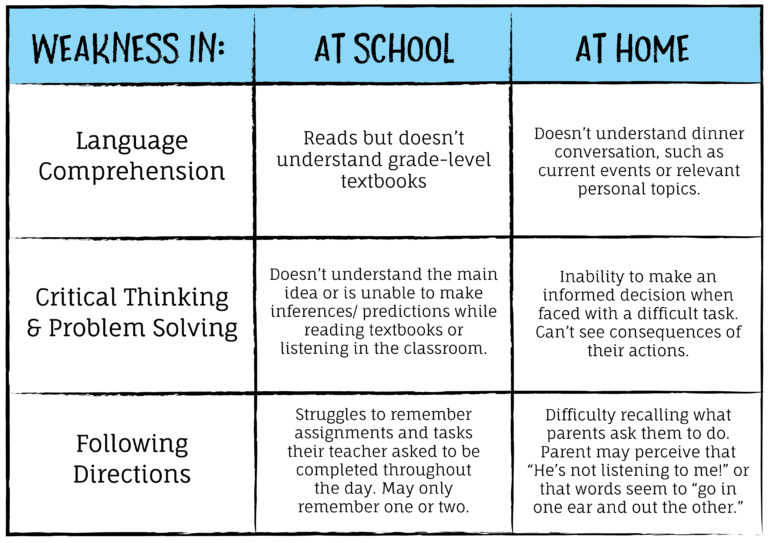
 

The imagery-language connection is key to good thinking and communication. You can help address comprehension in the following ways:


1. In conversation

During discussions with your child about their day or current events in the news, use imagery-stimulating questions.  For example, instead of asking, “What do you think about…?” you can ask, “What did you picture for that story in the news today?”  or “What are you picturing for what might happen next?” You can expand upon these questions to dive into their images even more.


2. When reading together

After you or your child reads aloud or listen to a story together, you can gauge comprehension by asking some imagery questions. “How did you see that happening?” or “What do you picture happening next?” can begin a fun discussion of the story and allow you to see what your child is getting out of it.


3. When there’s a problem to solve

Help your child target specific images they’re creating while they’re processing oral or written language. Teach them to continually ask themselves whether they understand what the consequences may be of certain actions, and if they’re able to picture the outcome: “If I do this, what might happen? What does that look like?”


4. When you give instructions

Establish an imagery-language connection through daily life activities to stimulate learning.  For example, when giving your child instructions, such as brushing their teeth, getting dressed, or making their bed, ask your child to picture these tasks in their mind before they do them.


5. When learning something new

Whether your child is learning the rules of Monopoly for the first time or helping you get through a favourite cookie recipe, prompting your child to visualise the language is a great start. You can also fall back on the imagery-language connection to check for understanding and to answer questions. For example, “What do you see for ‘bankrupt’?”


Comprehension Solutions at Lindamood-Bell

The imagery-language connection can be developed as a foundation for comprehension and thinking. Students can make years of growth in just a few weeks.

An accurate learning ability evaluation is the first step toward helping your child learn to their potential. We uncover the strengths and weaknesses that are affecting comprehension, and in a thorough results consultation, we will discuss a learning plan to change learning in the shortest time possible. Recommendations are differentiated based on the unique learning needs of each student.


Contact us to learn more or get started: Double Bay (02) 9328 7119 | Chatswood (02) 9410 1006 | Melbourne (03) 9815 2949.

 

Connect with us
Start 2026 Strong with Workshop Savings ✨

Kick off the year with special pricing on Lindamood-Bell for Schools professional development, aligned with the Science of Reading.
✔ Save 25% when you bring a colleague or bundle workshops
✔ Group inservice training discounts up to 25% available

Use code HELLO26BOGO

⏰ Offers end January 31, 2026.
👉 View the workshop schedule and reserve your spot.
🔗 Link in bio @lindamoodbellofficial
✨ Experience the Lindamood-Bell Academy Difference!
 
📅 Jan 12–16 | Academy Week
See firsthand how we help students build their learning ability while thriving in a full academic curriculum.

🎓 Special Enrollment Offer available!
 Tap the link in our bio @lindamoodbellofficial to learn more.
📚 Teaching students to connect language with imagery strengthens reading skills and comprehension.

At Lindamood-Bell, our approach is grounded in Dual Coding Theory (DCT), a cognitive framework explaining how the brain processes information. Our founders’ programs, including Seeing Stars for reading and spelling and Visualizing and Verbalizing for comprehension and critical thinking, apply these principles through sensory-cognitive instruction.

✨ See how our approach translates into classroom practice and the real results it produces for students.
Read the full article - tap the link in our bio, @lindamoodbellofficial.
📖 Want to help your child build strong reading skills from the very start?
Our latest blog, Developing Early Literacy Skills: A Parent’s Guide to Supporting Young Readers, shares practical tips for nurturing language, decoding, and comprehension at home. Discover how everyday reading and playful activities can spark curiosity and confidence.
✨ Learn how personalized support at Lindamood-Bell can strengthen the foundational skills your child needs to succeed in school and beyond.
Tap the link in our bio, @lindamoodbellofficial.
As we close out the year, we’re grateful for the trust you place in Lindamood-Bell and for our shared commitment to helping individuals learn to their full potential. 
Wishing you a holiday season filled with rest, joy, and connection, and a 2026 full of inspiration and possibility.
See the difference the right instruction can make. 💙
Miss Georgia’s Teen, Carrington Manous, shares how dyslexia once left her feeling discouraged about school and learning, and how Lindamood-Bell helped her build the skills and confidence to succeed. Today, she uses her voice to advocate for students with learning differences and to expand access to effective instruction.
🎥 Watch Carrington’s full, inspiring story. Link in bio at @lindamoodbellofficial.
Parents, ❄️ Winter Break ❄️ is a great time to give your child a boost. For a limited time, enjoy 10% off instruction. Contact your Learning Center to get started!
❄️ Don’t miss our Winter Wonderland Learning Savings!❄️
📚 10% OFF instruction during Winter Break!
Help your child catch up, conquer learning loss, or get ahead. Our individualized instruction will set them up for success and confidence in the New Year.
👉 Visit our website for details and to get started today! Follow the link in our bio, @lindamoodbellofficial.
See the impact our Lindamood-Bell instruction can have! This family shares how our evidence-based approach helped their child thrive. 🎥 Watch their full story and get inspired. Follow the link in bio, @lindamoodbellofficial.

❄️ Parents, winter break is the perfect time to give your child a boost! For a limited time, enjoy 10% off instruction. Contact your Learning Center to get started!
Our free webinar featuring Paul Worthington, Director of Research and Development, is now available to watch.
Learn how evidence-based instruction, the Cognitive Science of Learning, and effective leadership strategies can help drive meaningful, sustainable improvements in student learning.
▶️ Watch now at the link in bio, @lindamoodbellofficial.
Reading fluency isn’t about extra drills or repetition.

It grows when students strengthen the sensory-cognitive foundation behind accurate, automatic reading. 

Symbol imagery is key. Visualizing sounds and letters in words helps students:
 • Decode accurately
 • Recognize words automatically
 • Enjoy reading

Discover why symbol imagery matters and how educators can build fluency. Read the full article at the link in our bio, @lindamoodbellofficial.
📣 Attending the SENIA International 2025 Virtual Conference?

🎓 Don’t miss our session:
Join Melissa Garner, Director of Lindamood-Bell for Schools, for “Closing the Comprehension Gaps in the Science of Reading” on November 21, 1:30–2:45 PM. Melissa will explore how developing concept imagery builds comprehension, vocabulary, critical thinking, and writing. 

💻 Visit Our Virtual Booth:
Stop by the Lindamood-Bell booth to learn more about our sensory-cognitive approach and how it supports educators in helping all students reach their learning potential.

Get more info at the link in our bio, @lindamoodbellofficial.
Educators, join us for a free Lindamood-Bell webinar with Paul Worthington, Director of Research and Development.
Discover how evidence-based instruction, the Cognitive Science of Learning, and effective leadership strategies can drive meaningful, sustainable improvements in student learning.

🗓 Wednesday, December 3rd | 11 am PST | 2 pm EST | 7 pm GMT

Can’t join live? Register anyway, and we’ll send you the recording!
Link in bio, @lindamoodbellofficial.
At Lindamood-Bell, we align with the principles of the Science of Reading and expand upon them, offering programs rooted in the Cognitive Science of Learning.
Our goal is to unlock every student’s potential with targeted instruction that strengthens the sensory-cognitive foundations of reading and comprehension.
Visit our blog to see how our Science of Reading-aligned curriculum is transforming learning in schools every day! 🌟
🔗 Link in bio, @lindamoodbellofficial
📚 Every Student Can Thrive with the Right Support
At Lindamood-Bell Academy, students with dyslexia receive personalized, one-to-one instruction that builds reading skills, confidence, and a love of learning. Our evidence-based approach helps students overcome challenges and succeed in school and life.
Discover how our school can transform your child’s learning journey. Tap the link in bio, @lindamoodbellofficial.
Request Information

Request Information

When you complete our form, we'll send you to our digital information packet and reach out to you shortly.
You may also call us at


* required

Schedule a Learning
Ability Evaluation

Please fill out the form and we will be in touch to schedule an evaluation.

* required