




Should we expand our understanding of the cognitive sciences that support reading instruction?
What’s missing in the “Science of Reading” movement? While current reform efforts capture some basic components of evidence-based methods, they are limited in scope and insufficient for all learners, especially the most disadvantaged readers. The cognitive sciences that inform the processes of reading offer a more comprehensive and up to date approach to improving literacy skills.
The Cognitive Science of Learning
Lindamood-Bell’s approach is based on the cognitive science of learning, with instruction that is informed by the science of the reading brain and its mental processes. Importantly, reading is a cognitive act and any approach to reading must align with theories of cognition (Sadoski & Willson, 2006). Learning to read involves multisensory integration of auditory (phonological), visual (orthographic), and language (linguistic) modalities, and also cognitive processes such as imagery/mental representations, working memory, long-term memory, and metacognition (Bell, McCallum, and Cox, 2003; McCallum et al., 2006; Kosslyn, 1994; Sadoski, McTigue, & Paivio, 2012).
For skilled reading, there are sensory-cognitive factors (Bell, 1991; Lindamood, Bell, and Lindamood, 1997) underlying reading skills (i.e., letter-sound knowledge, phonics, orthography, fluency, vocabulary, comprehension). One sensory-cognitive factor, phonological awareness, is well understood and generally recognized as an essential skill for reading (National Reading Panel, 2000). This is largely due to the research and development of phonemic awareness instruction, pioneered by Pat Lindamood, one of the founders of Lindamood-Bell.
There are two other sensory-cognitive factors we are concerned with, related to imagery, which influence language, literacy, and learning ability: symbol imagery and concept imagery (Bell, 2007; Bell 2013). These two sensory-cognitive factors are often critical missing processes for struggling readers and not explicitly developed in most instructional approaches. The role of imagery in literacy skills, both for decoding and comprehension, is supported by a well established theory of general cognition known as Dual Coding Theory, or DCT (Sadoski, McTigue, & Paivio, 2012; Sadoski & Krasny, 2018). DCT has implications for the cognitive processes of mental representations, memory, and metacognition.
Most reading instruction based on the current Science of Reading movement overemphasize phonological awareness and phonics with little to no attention to orthographic processing, fluency, or comprehension, all hallmarks of automaticity and skilled reading. While phonological awareness and phonics are necessary, they alone are not sufficient. For poor readers, sensory-cognitive skills, including symbol imagery and concept imagery should be addressed to maximize their potential for instruction in the component parts of reading. And for emerging readers (K-2), these skills can be explicitly developed for the foundations of reading to reduce the number of students who may eventually struggle to read. An extensive research base supports this approach to literacy instruction.
How Sensory-Cognitive Instruction Goes Beyond the Science of Reading
1. Comprehension
The Science of Reading movement emphasizes the Simple View of Reading (Gough & Tunmer, 1986), a statistical model that focuses on word reading (decoding) and language skills correlated to reading comprehension. However, many students have a separate comprehension/sensory-cognitive weakness despite adequate decoding and oral language skills (Duke and Cartwright, 2021). For these students, instruction in the Visualizing and Verbalizing® program develops processes (concept imagery, mental models) that underlie comprehension.
2. Orthographic and phonological processing
The Science of Reading is narrowly interpreted as a structured literacy approach, which overemphasizes early decoding skills with little attention to orthographic processing, automatic word recognition, and fluency. For global reading skill, the Seeing Stars® program develops symbol imagery as a basis for phonological and orthographic processing for automaticity in reading.
3. Dyslexia
Many students with, or at risk for, dyslexia continue to struggle with reading despite explicit and systematic instruction in phonemic awareness and phonics principles. Students learn how to discriminate sounds in words and apply lots of phonics rules (almost too well), but struggle to read fluently in text, which may also impact their ability to comprehend the text. Sensory-cognitive instruction is often the critical missing piece in helping struggling students overcome their reading difficulty.
4. Intensive intervention
Most interventions are light touch (i.e., two to three days per week for only 15 to 30 minutes per session) and include too many strategies and instructional routines that are unnecessary for most students (e.g, Advanced Phonemic Awareness). Most are inefficient and have limited impact on accelerating reading skill. Our approach emphasizes intensity and focus on sensory-cognitive skills to address the underlying root cause(s) of poor reading. This approach changes the rate of processing, helping students to close the gap in reading.
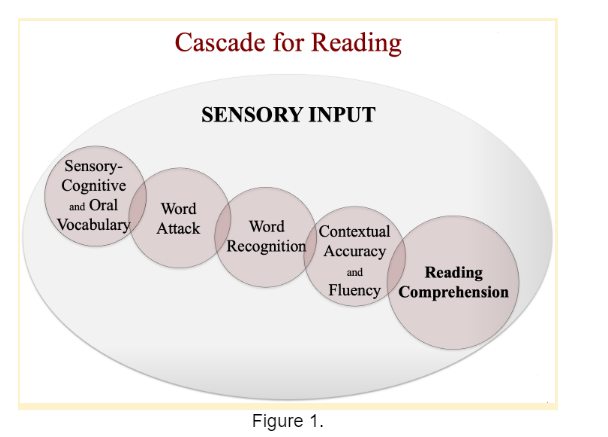
5. Cascade for reading (See Figure 1)
The cascade presents a conceptual model of the component parts, similar to other models of reading such as Scarborough’s Rope (Scarborough, 2001). In our approach, development of sensory-cognitive processes AND the component parts of reading is explicit, systematic, and prescriptive, differentiated based on student need. Conscious awareness of the sensory input of imagery/mental representations is unique to this approach and enables skills to spill over, or cascade, through reading development for independence in reading.
Nanci Bell (2013), the Director of Lindamood-Bell and a literacy expert and author, noted “the complex skill of reading requires the integration and interplay of several component subskills of reading. And it also requires an automatic, nearly unconscious performance of those subskills that is enabled by the activation of imagery at a conscious level. Bringing imagery to consciousness with explicit instructional methodology will profoundly improve literacy skills” (p. 49).
References
Bell, N. (1991). Gestalt imagery: A critical factor in language comprehension. Annals of Dyslexia, 41(1), 246-260. doi:10.1007/BF02648089
Bell, N. (2007). Visualizing and Verbalizing for Language Comprehension and Thinking (2nd edition) Gander Publishing.
Bell, N. (2013). Seeing Stars: Symbol imagery for Phonological and Orthographic Processing in Reading and Spelling (2nd edition). Gander Publishing.
Bell, S. M., McCallum, R. S., & Cox, E. A. (2003). Toward a research-based assessment of dyslexia: using cognitive measures to identify reading disabilities. Journal of learning disabilities, 36(6), 505–516. https://doi.org/10.1177/00222194030360060201
Duke, N.K., & Cartwright, K.B. (2021). The Science of Reading Progresses: Communicating Advances Beyond the Simple View of Reading. Reading Research Quarterly, 56 (S1) pp. S25 -S44.
Gough, P. B., & Tunmer, W. E. (1986). Decoding, Reading, and Reading Disability. Remedial and Special Education, 7(1), 6-10. https://doi.org/10.1177/074193258600700104
Kosslyn, S.M. (1994). Image and brain: The resolution of the imagery debate. The MIT Press.
Lindamood, P. C., Bell, N., & Lindamood, P. D. (1997). Sensory-cognitive factors in the controversy over reading instruction. Journal of Developmental and Learning Disorders 1(1), 143-182. Retrieved from http://www.icdl.com/bookstore/icdl-publications/journal-of-development-and-learning
McCallum, R. S., Bell, S. M., Wood, M. S., Below, J. L., Choate, S. M., & McCane, S. J. (2006). What is the role of working memory in reading relative to the big three processing variables (orthography, phonology, and rapid naming)?. Journal of Psychoeducational Assessment, 24(3), 243-259. https://doi.org/10.1177/0734282906287938 .
National Reading Panel (US), National Institute of Child Health, & Human Development (US). (2000). Teaching children to read: An evidence-based assessment of the scientific research literature on reading and its implications for reading instruction: Reports of the subgroups. National Institute of Child Health and Human Development, National Institutes of Health. https://www.nichd.nih.gov/sites/default/files/publications/pubs/nrp/Documents/report.pdf
https://doi.org/10.1093/cercor/bhx131
Sadoski, M., & Krasny, K. A. (2018). Dual coding theory: An embodied theory of literacy. In D.E. Alvermann, N.J. Unrau, M. Sailors, & R.B. Ruddell (Eds.), Theoretical Models and Processes of Literacy (7th ed., pp. 161-177). Routledge.
Sadoski, M., McTigue, E. M., & Paivio, A. (2012). A dual coding theoretical model of decoding in reading: Subsuming the Laberge and Samuels model. Reading Psychology, 33(5), 465-496. https://doi.org/10.1080/02702711.2011.557330
Sadoski, M., & Willson, V. L. (2006). Effects of a Theoretically Based Large-Scale Reading Intervention in a Multicultural Urban School District. American Educational Research Journal, 43(1), 137-154. https://doi.org/10.3102/00028312043001137
Scarborough, H. S. (2001). Connecting early language and literacy to later reading (dis)abilities: Evidence, theory, and practice. In S. Neuman & D. Dickinson (Eds.), Handbook for Research in Early Literacy. Guilford Press.
 ×