The Science of Reading and Lindamood-Bell
Lindamood-Bell goes beyond the Science of Reading by incorporating the Cognitive Science of Learning, embracing the brain-based codes of learning beyond written language. Our approach emphasizes sensory-cognitive skills—symbol imagery (orthographic processing) and concept imagery (mental representations)—essential for decoding, fluency, and oral and written language comprehension. Though overlooked in the Science of Reading, these skills are crucial for developing lifelong learners, not just readers.
Since 1986, Lindamood-Bell has led evidence-based instruction for early literacy, struggling readers, and students with learning challenges such as dyslexia, dyscalculia, and memory and language comprehension deficits, including autism. While some of our methods align with the Science of Reading, our unique focus on sensory-cognitive skills provides a crucial foundation for improving reading fluency and comprehension.
Enhancing the Science of Reading: Exploring the Science of Learning and Sensory-Cognitive Functions

The “Science of Reading” (SoR) has been adopted by most reading programs and is legislated in the majority of states. Although ongoing literacy reform initiatives, using the SoR as the basis for improving reading, encompass some fundamental findings of peer-reviewed research, they are inadequate for what is necessary to learn how to read, particularly for those who struggle the most with reading. Current research in the cognitive sciences offers a more robust evidence-based science, including a new theoretical model that includes reading, and literacy, within the larger framework of learning.
The Cognitive Science of Learning
While learning to decode entails integrating auditory (phonological), visual (orthographic), and language (linguistic) modalities, there is a more comprehensive set of cognitive processes using mental representations/multi-sensory imagery that is foundational for decoding, oral and written language comprehension, working memory, long-term memory, and metacognition. These additional processes are grounded in a second mental representational code, beyond just language, in the brain necessary for all learning, called Dual Coding Theory (DCT) (Paivio, 1971; Bell et al., 2003; McCallum et al., 2006; Kosslyn, 1994; Sadoski et al., 2012).
Lindamood-Bell’s approach to literacy instruction is based on a Cognitive Science of Learning, including the reading brain and its more formative sensory-cognitive processes. Recognizing that reading is based on utilizing the sensory codes in the brain necessary to learn has led to a deeper understanding of what it takes to learn to read. Learning to read is a crucial cognitive activity, and any reading approach must align with a theory of cognition (Sadoski & Willson, 2006). The SoR is based on the teaching or stimulation of a singular code, language, predominantly the teaching of phonics—learning to decode and encode. While teaching reading through stimulation of the component parts of language is necessary, it is not sufficient based on a large corpus of research in cognitive science.
For proficient reading, these imaginal sensory-cognitive factors (Bell, 1991; Lindamood et al., 1997) underlie reading skills (e.g., letter-sound knowledge, phonics, orthography, fluency, vocabulary, comprehension). One crucial sensory-cognitive factor in the language code is phonological awareness, acknowledged as a fundamental skill for reading (National Reading Panel, 2000), largely due to the pioneering work in phonemic awareness instruction by Pat Lindamood, a co-founder of Lindamood-Bell.
Symbol imagery and concept imagery are two additional critical sensory-cognitive factors related to imagery, which significantly impact language, literacy, and learning abilities (Bell, 2007; Bell, 2013). Despite their importance, these factors are often crucially overlooked or assumed in instructional approaches for struggling readers. The significance of imagery in literacy skills, for both decoding and comprehension, is supported by the well-established DCT in general cognition (Sadoski et al., 2012; Sadoski & Krasny, 2018), which has implications for mental representations, memory, and metacognition.
While phonological awareness and phonics are essential, they alone are insufficient. Sensory-cognitive skills like symbol imagery and concept imagery should be addressed to help poor readers maximize their learning potential in reading. These skills should be explicitly developed in emerging readers (K-2) to establish strong reading foundations and reduce the likelihood of future reading difficulties. Extensive research supports this approach to literacy instruction.
How Sensory-Cognitive Instruction Expands on the Science of Reading
1. Comprehension: The SoR emphasizes the Simple View of Reading (Gough & Tunmer, 1986), focusing on word reading (decoding) and language skills linked to reading comprehension. However, many students struggle with separate comprehension/sensory-cognitive weaknesses despite adequate decoding and oral language skills (Duke & Cartwright, 2021). The Visualizing and Verbalizing® program addresses these weaknesses by developing processes like concept imagery, the mental representational code crucial for comprehension.
2. Orthographic and phonological processing: The SoR, often seen as a structured literacy approach, heavily emphasizes early decoding skills but underestimates the orthographic processing (symbol imagery) necessary for automatic word recognition and fluency. For comprehensive reading skills, the Seeing Stars® program focuses on developing symbol imagery as the foundation for phonological and orthographic processing, leading to reading automaticity.
3. Dyslexia: Many students with dyslexia struggle despite explicit instruction in phonemic awareness and phonics principles. While they may excel in sound discrimination and phonics rules, they often struggle with fluent reading, affecting comprehension. Sensory-cognitive instruction fills this gap, aiding struggling students in overcoming reading difficulties.
4. Intensive intervention: Most intervention models are not intensive enough and include unnecessary linguistic strategies and routines, often inefficient in accelerating reading skills. Our approach prioritizes intensity and focuses on sensory-cognitive skills to address the root cause(s) of poor reading, enhancing processing rates and bridging the reading gap.
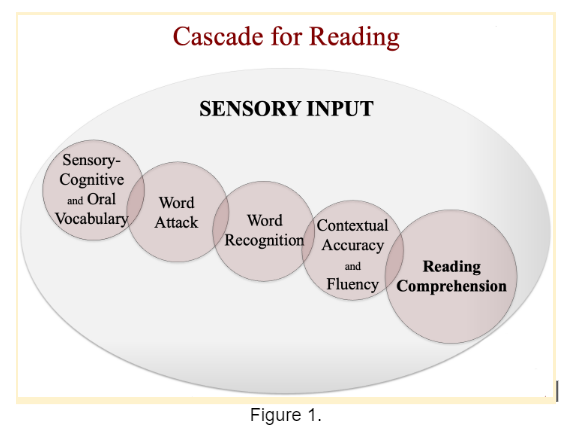
5. Cascade for Reading (Figure 1): The cascade model illustrates the interconnected parts of reading. Our approach explicitly and systematically develops sensory-cognitive processes and reading components tailored to individual student needs. Consciously integrating sensory input like imagery/mental representations distinguishes this approach, facilitating skill transfer and independence in reading.
Nanci Bell (2013), literacy expert, author, and co-founder of Lindamood-Bell, noted, “The complex skill of reading requires the integration and interplay of several component subskills of reading. It also requires an automatic, nearly unconscious performance of those subskills that is enabled by the activation of mental representations (imagery) at a conscious level. Bringing imagery to consciousness with explicit instructional methodology will profoundly improve literacy skills” (Bell, 2013, p. 49).
Beyond the Science of Reading: The Cognitive Science of Learning and Dual Coding Theory
The limitations of the “Science of Reading” approach are evident, particularly in its narrow focus on decoding and language skills, overlooking crucial sensory-cognitive factors essential for comprehensive literacy development. The Cognitive Science of Learning, DCT, emphasizes the integration of sensory modalities and cognitive processes necessary for proficient reading. Sensory-cognitive factors such as phonological awareness, symbol imagery, and concept imagery play a pivotal role in literacy instruction, addressing the needs of struggling readers and creating a strong foundation for reading.
Nanci Bell’s insights underscore the significance of bringing imagery to consciousness through explicit instructional methodologies, leading to profound improvements in literacy skills. By expanding beyond the SoR and embracing DCT through the stimulation of sensory-cognitive functions, educators can better equip students with the essential skills for successful reading and comprehension.
Through targeted interventions like the Visualizing and Verbalizing® program and Seeing Stars® program, students can develop the necessary sensory-cognitive skills alongside traditional reading components, creating a holistic approach to literacy instruction. This comprehensive framework not only addresses the diverse needs of learners but also promotes lifelong literacy success.
Integrating a Cognitive Science of Learning that explicitly addresses Sensorimotor functions into literacy instruction marks a significant advancement in enhancing reading abilities. It paves the way for more inclusive and effective educational practices that promote literacy for all learners.
Resources for Educators

At Lindamood-Bell, we offer professional development workshops in our approach, which is based on the cognitive science of learning and aligns with the Science of Reading and structured literacy. It is unique in its focus on the sensory-cognitive skill of imagery, often a critical missing component for struggling readers, as a basis for reading fluency and language comprehension. Educators may learn the steps of the programs authored by Lindamood-Bell’s founders:
Reading and Spelling Programs
Symbol Imagery for Phonological and Orthographic Processing in Reading and Spelling
Lindamood Phoneme Sequencing (LiPS)
Phonemic Awareness for Reading, Spelling, and Speech
Comprehension Programs
Visualizing and Verbalizing (VV)
Concept Imagery for Language Comprehension, Thinking, and Memory
Foundational Development in Concept Imagery, Oral Language Comprehension, and Expression
A Teacher’s Perspective
Special Educator Sonya Bledsoe describes her experience using the Seeing Stars program with her students:
Explore our schedule of online professional development workshops or click here to schedule a brief consultation with a program expert.
We look forward to helping you provide evidence-based instruction that will help your students reach their full potential.
References
Bell, N. (1991). Gestalt imagery: A critical factor in language comprehension. Annals of Dyslexia, 41(1), 246–260. doi:10.1007/BF02648089
Bell, N. (2007). Visualizing and Verbalizing for Language Comprehension and Thinking (2nd edition) Gander Publishing.
Bell, N. (2013). Seeing Stars: Symbol Imagery for Phonological and Orthographic Processing in Reading and Spelling (2nd edition). Gander Publishing.
Bell, S. M., McCallum, R. S., & Cox, E. A. (2003). Toward a research-based assessment of dyslexia: using cognitive measures to identify reading disabilities. Journal of learning disabilities, 36(6), 505–516. https://doi.org/10.1177/00222194030360060201
Duke, N.K., & Cartwright, K.B. (2021). The Science of Reading Progresses: Communicating Advances Beyond the Simple View of Reading. Reading Research Quarterly, 56 (S1) pp. S25 -S44.
Gough, P. B., & Tunmer, W. E. (1986). Decoding, Reading, and Reading Disability. Remedial and Special Education, 7(1), 6–10. https://doi.org/10.1177/074193258600700104
Kosslyn, S.M. (1994). Image and brain: The resolution of the imagery debate. The MIT Press.
Lindamood, P. C., Bell, N., & Lindamood, P. D. (1997). Sensory-cognitive factors in the controversy over reading instruction. Journal of Developmental and Learning Disorders 1(1), 143-182. Retrieved from http://www.icdl.com/bookstore/icdl-publications/journal-of-development-and-learning
McCallum, R. S., Bell, S. M., Wood, M. S., Below, J. L., Choate, S. M., & McCane, S. J. (2006). What is the role of working memory in reading relative to the big three processing variables (orthography, phonology, and rapid naming)? Journal of Psychoeducational Assessment, 24(3), 243–259. https://doi.org/10.1177/0734282906287938 .
National Reading Panel (US), National Institute of Child Health & Human Development (US). (2000). Teaching children to read: An evidence-based assessment of the scientific research literature on reading and its implications for reading instruction: Reports of the subgroups. National Institute of Child Health and Human Development, National Institutes of Health. https://www.nichd.nih.gov/sites/default/files/publications/pubs/nrp/Documents/report.pdf
Paivio, A. (1971). Imagery and verbal processes. New York: Holt, Rinehart, and Winston.
Sadoski, M., & Krasny, K. A. (2018). Dual coding theory: An embodied theory of literacy. In D.E. Alvermann, N.J. Unrau, M. Sailors, & R.B. Ruddell (Eds.), Theoretical Models and Processes of Literacy (7th ed., pp. 161-177). Routledge.
Sadoski, M., McTigue, E. M., & Paivio, A. (2012). A dual coding theoretical model of decoding in reading: Subsuming the Laberge and Samuels model. Reading Psychology, 33(5), 465-496. https://doi.org/10.1080/02702711.2011.557330
Sadoski, M., & Willson, V. L. (2006). Effects of a Theoretically Based Large-Scale Reading Intervention in a Multicultural Urban School District. American Educational Research Journal, 43(1), 137-154. https://doi.org/10.3102/00028312043001137
Scarborough, H. S. (2001). Connecting early language and literacy to later reading (dis)abilities: Evidence, theory, and practice. In S. Neuman & D. Dickinson (Eds.), Handbook for Research in Early Literacy. Guilford Press.