article

Tag Archives: numeral imagery

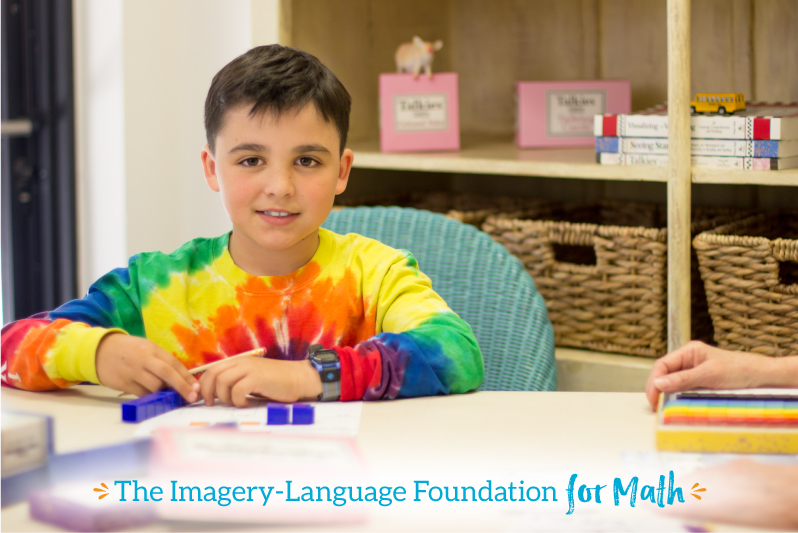
The Imagery-Language Foundation for Math


Many students can grasp addition and subtraction problems using math manipulatives. But take away the concrete objects and their understanding seems to disappear.


Manipulatives are a very helpful visual representation, but math students of all ages need to learn to visualize what numbers mean as well.


Mathematics is cognitive processing, or thinking, that requires both imagery and language. Imagery is fundamental to the process of thinking with numbers.


The primary cause of math difficulties is a weakness in two areas: numeral imagery—the ability to visualize numbers—and concept imagery—the ability to process the gestalt (whole) from language. Individuals who demonstrate weaknesses in these areas often attempt to memorize math facts instead of being able to think, reason, and problem solve with numbers.


People who are great at math can easily visualize math functions. The language of numbers turns into imagery and they “see” mathematical relationships. However, many individuals may experience an inability to image the concepts underlying math processes. This causes weakness in the following:


  • Learning math facts
  • Grasping mathematical relationships
  • Following proper mathematical operations
  • Solving word problems
  • Estimating numerical values
  • Understanding higher level math


The following excerpt from On Cloud Nine Math by Nanci Bell and Kimberly Tuley, explains the importance of both concept and numeral imagery:


“To bring concept and numeral imagery to a conscious level as the missing link in math instruction, On Cloud Nine integrates and applies the principles of Bell’s programs: Visualizing and Verbalizing for Language Comprehension and Thinking (V/V) and Seeing Stars: Symbol Imagery for Phonological and Orthographic Processing in Reading and Spelling (SI). As individuals become familiar with the concrete manipulatives, they are questioned and directed to consciously transfer the experienced to the imaged. They image the concrete and attach language to their imagery. The integration of imagery and language is then applied to computation. They develop the sensory-cognitive processing to understand and use the logic of mathematics in mental and written computation.”


The On Cloud Nine Math program stimulates an individual’s ability to image and verbalize the concepts underlying math processes. Concept and numerical imagery are integrated with language and applied to math computation and problem solving. There is emphasis on both mathematical reasoning and mathematical computation.


Explore our math instruction, including Learning Center results, here.


Educators: Find out how you can learn the steps of the On Cloud Nine Program in one of our acclaimed professional development workshops, and teach your students how to “see” math, here.


Connect with us
🎉 40 Years of Changing Lives Through Learning

Our next milestone takes us to 1992!

📍 1992: First Learning Center outside of San Luis Obispo opens in Sacramento, California

Six years after Lindamood-Bell was founded, we expanded beyond our San Luis Obispo roots with the opening of a Learning Center in Sacramento.

It was an important step in our growth, bringing Lindamood-Bell’s one-to-one, individualized instruction to more students and families.

Follow @lindamoodbellofficial as we celebrate 40 years of changing lives through learning and revisit the milestones that shaped our story. ❤️

Learn more at the link in our bio.
🎥 Now Available On-Demand: Online Instruction That Actually Works

When you think of online learning, you might picture large virtual classrooms where it can be difficult for students to stay engaged. Lindamood-Bell online instruction is a different experience: live, one-to-one instruction with individualized support and active student engagement.

See what an online session actually looks like and learn about the research and results behind our reading instruction.

👉 Watch the recording at the link in our bio, @lindamoodbellofficial.
🎉 40 Years of Changing Lives Through Learning
As we continue looking back at the milestones that have shaped Lindamood-Bell, we’re returning to where it all began.

📖 1986: Nanci Bell publishes Visualizing and Verbalizing®

The same year Lindamood-Bell Learning Processes was founded, co-founder Nanci Bell published Visualizing and Verbalizing for Language Comprehension and Thinking®, introducing an approach designed to develop concept imagery, the ability to create an imaged gestalt from language.

The program grew from Nanci’s work with students who could read words but struggled to understand, remember, and think critically about what they read.
Today, Visualizing and Verbalizing® remains central to our approach to developing language comprehension and higher-order thinking skills.

Follow @lindamoodbellofficial as we celebrate 40 years of changing lives through learning. ❤️
Learn more at the link in our bio.
🎧 New Podcast Episode!

Lindamood-Bell for Schools Director of Development Dave Kiyvyra speaks with Winifred Winston and LeDerick Horne from the Black and Dyslexic podcast about the dyslexia identification and support gap.

They explore disparities in dyslexia identification, limited access to effective reading instruction in many communities, and the challenges families face in understanding and securing the support their children need.

Listen and subscribe at the link in our bio, @lindamoodbellofficial.
📚 When should kids start reading?

Our latest blog article explores typical reading milestones, signs of readiness, the foundational skills that support reading and comprehension, and when additional support may be helpful.

👉 Read “When Should Kids Start Reading? Age Guidelines, Readiness Signs, and How to Help.” Follow the link in our bio, @lindamoodbellofficial.
🎉 40 Years of Changing Lives Through Learning

This year marks a very special milestone for Lindamood-Bell: 40 years!

Over the coming weeks, we’ll be looking back at some of the milestones that have shaped our story. From our beginnings in 1986 to the work we do today, there is so much to celebrate.

And where better to begin than at the beginning?

📷 1986: Lindamood-Bell Learning Processes is founded.

Pat Lindamood and Nanci Bell co-founded Lindamood-Bell with a shared belief that all students can be taught to read to their potential. From the beginning, our approach was grounded in the understanding that reading is a sensory-cognitive process and that the underlying skills can be developed.

What began 40 years ago has grown into a journey we’re excited to revisit and share with you.

Follow @lindamoodbellofficial as we celebrate 40 years of changing lives through learning and share more milestones from our story.

For more information about Lindamood-Bell, visit the link in our bio. ❤️
Considering online homeschooling for your child? There’s a lot to think about beyond curriculum and flexibility.

How will instruction be personalized? Will your child have live interaction with teachers? What kind of support and school community will they have? And will the program help strengthen the learning skills they need to succeed?

Our new guide explores what families should consider when comparing online homeschool programs and how Lindamood-Bell Academy approaches learning from home.

Read Online Homeschool Programs: A Guide for Families at the link in our bio, @lindamoodbellofficial.
New Podcast Episode!
Tom Mendoza, Co-Director of Lindamood-Bell for Schools, and Deci Douroux, Professional Development Mentor Presenter, explore how developing concept and numerical imagery can help close math achievement gaps.
They discuss a three-step instructional approach that moves students from hands-on experiences with manipulatives to imagery and language, then to computation and problem-solving. Learn how this approach can support stronger number sense, mathematical reasoning, and confidence.
Listen and subscribe at the link our bio, @lindamoodbellofficial
What’s the difference between Lindamood-Bell and Orton-Gillingham?

Our latest blog article explores the similarities and key differences between these approaches, including Lindamood-Bell’s emphasis on developing the sensory-cognitive processes that underlie reading, spelling, and comprehension.

Read the full article at the link in bio, @lindamoodbellofficial.
🎧 New Podcast Episode: A Parent’s Perspective on Lindamood-Bell Live-Online Instruction for Dyslexia
In our latest podcast episode, a mother shares her son’s journey with dyslexia and the impact personalized instruction had on his reading skills and confidence.
Through a combination of live-online and in-person reading instruction at our Learning Center, he developed the skills he needed to make meaningful academic progress.
Hear his story and his mother’s perspective on their Lindamood-Bell experience.
👉 Listen to the full episode at the link in our bio, @lindamoodbellofficial.
🍂 Fall workshops are here, educators!
Strengthen your teaching with live-online workshops grounded in the cognitive science of learning and aligned with the science of reading and structured literacy.
• Practical strategies for reading, comprehension, and math
• Support for students with dyslexia, ADHD, and autism
Save 10% with code 26READY2LEARN10.
Reserve your spot through the link in our bio, @lindamoodbellofficial.
Dyslexia is complex, but understanding its causes can help parents and educators make informed decisions about support. Our latest article explores what research tells us about dyslexia, common misconceptions, and the evidence behind effective intervention. Read more at the link in bio, @lindamoodbellofficial.
What is phoneme awareness, and why does it matter for learning to read?

Many people know phoneme awareness is important, but fewer understand how it fits into the bigger picture of reading development. Our latest blog explains what phoneme awareness is, how it differs from phonics, signs a student may need support, and why successful reading depends on more than phoneme awareness alone.
Whether you're a parent or educator, this guide offers practical insights into the sensory-cognitive functions that support reading.

Read the blog at the link in our bio, @lindamoodbellofficial.
Request Information

Request Information

When you complete our form, we'll send you to our digital information packet and reach out to you shortly.
You may also call us at

Schedule a Learning
Ability Evaluation

Please fill out the form and we will be in touch to schedule an evaluation.