
article

Tag Archives: comprehension instruction

I See Movies in My Head: The Key to Reading Comprehension

I See Movies in My Head:

The Key to Reading Comprehension

Most reading experts agree on one thing: In order to comprehend what they read, students must have strong decoding skills and adequate oral vocabulary. In other words, a child must be able accurately decode every word on the page, and know what all of the words mean.
img033

Unfortunately, many students who can decode well and understand words still have weak comprehension. What is the missing piece for these students?

Nanci Bell first became aware of the connection that underlies comprehension while she was teaching phoneme awareness  to students struggling with literacy, many of whom had been previously diagnosed as dyslexic. Nanci has described that at the time, she was unaware of a separate comprehension dysfunction. Like many others, she thought difficulty with reading comprehension was caused by weak decoding and weak oral vocabulary.

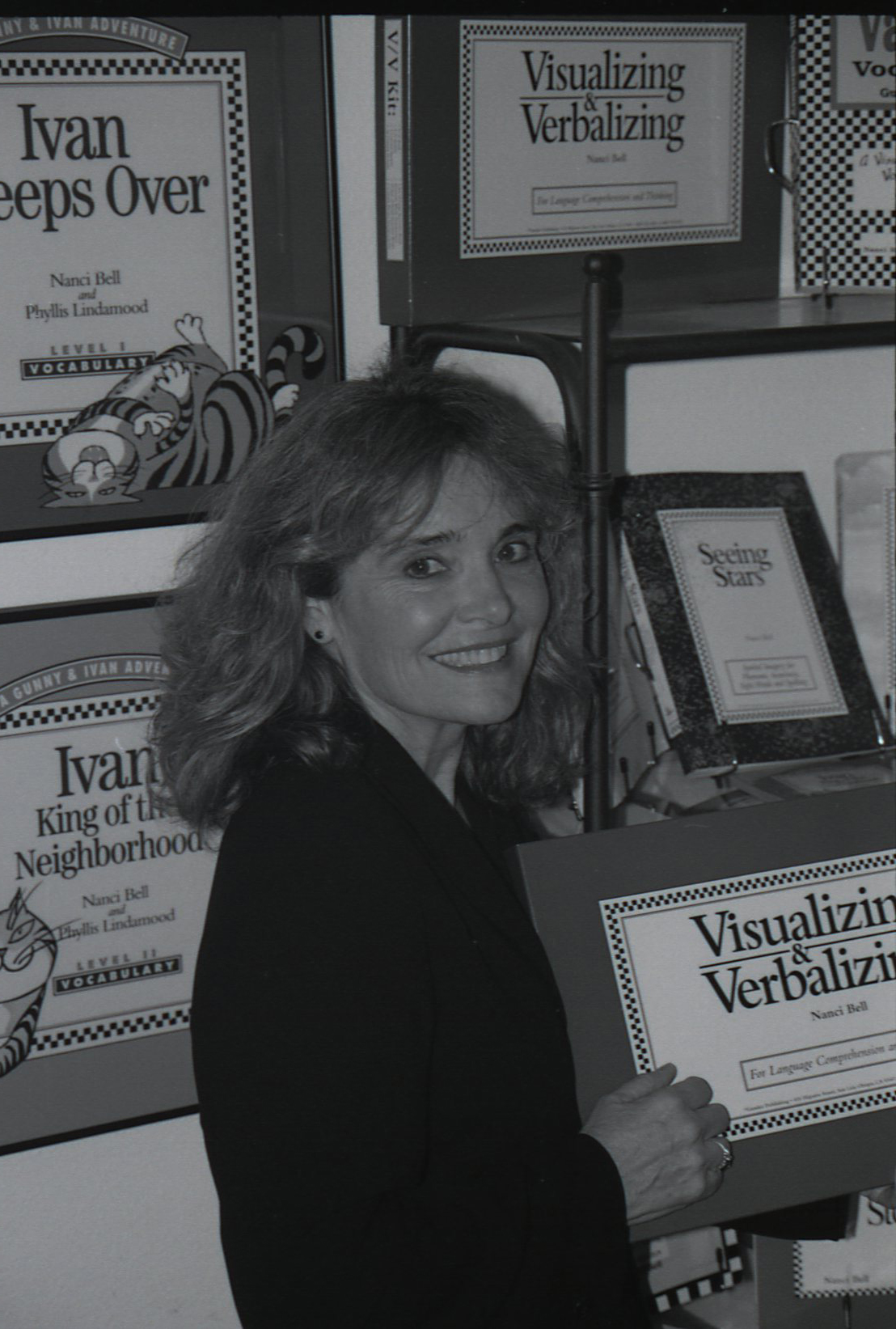
In the following excerpt, from Visualizing and Verbalizing, Nanci Bell describes the incident that sparked her passion to change learning for students struggling with weak comprehension.

………………………………………………….

Needing a break in the lesson from spelling word after word, I decide to have Allan,    [a college student majoring in architecture], read and give me a verbal summary.  Handing him a college level skill book, I ask him to read aloud so I can be certain he is decoding accurately.

He accurately reads the page of material, and I take the book from him, saying, “Good job.  Tell me what you read.”

Allan gives me the very complete summary, beginning with the main idea and then including all the details.  To my amazement, he infers, concludes, predicts, and evaluates the material.  He is confident and involved in the activity – a much different Allan than the one that struggles with spelling.

I stare at him, saying, “That was really an incredible summary.  How are you able to do that?”

Looking at me, surprised and now shy, Allan replies, “I don’t know.”

Realizing that Allan seems embarrassed and unsure of himself because of my question, I reassure him.  “That really was good.  You have very good reading comprehension.  How did you do that?  If I know what you do to remember what you read, perhaps I can teach others to do it.”

Thoughtful, Allan replies, “I don’t know.”  Then, after a pause, he says, “I make movies when I read.”

A little surprised, I ask, “What do you mean, you make movies when you read?”

“I don’t know.  I just see movies in my head when I read.  The words turn into pictures and I just remember the pictures, the images.  Don’t you do that?”

Thinking about the books I’ve read, I finally answer, “Yes.  I do.  I picture what I read.  I guess I’ve just not thought about it.”

“Do other people do that, too?”

“I don’t know … but I’ll find out …”

The statement “I make movies when I read” prompted my twenty-five-year-odyssey exploring the relationship between imagery and language.  Today, twenty years after first writing Visualizing and Verbalizing for Language Comprehension and Thinking, I am still passionate about the importance of imagery to comprehension and cognition. (Bell, 2007, pp. 4-8)

………………………………………………….

Learn how imagery-language instruction can improve comprehension and thinking:

https://lindamoodbell.com/program/visualizing-and-verbalizing-program



Connect with us
Start 2026 Strong with Workshop Savings ✨

Kick off the year with special pricing on Lindamood-Bell for Schools professional development, aligned with the Science of Reading.
✔ Save 25% when you bring a colleague or bundle workshops
✔ Group inservice training discounts up to 25% available

Use code HELLO26BOGO

⏰ Offers end January 31, 2026.
👉 View the workshop schedule and reserve your spot.
🔗 Link in bio @lindamoodbellofficial
✨ Experience the Lindamood-Bell Academy Difference!
 
📅 Jan 12–16 | Academy Week
See firsthand how we help students build their learning ability while thriving in a full academic curriculum.

🎓 Special Enrollment Offer available!
 Tap the link in our bio @lindamoodbellofficial to learn more.
📚 Teaching students to connect language with imagery strengthens reading skills and comprehension.

At Lindamood-Bell, our approach is grounded in Dual Coding Theory (DCT), a cognitive framework explaining how the brain processes information. Our founders’ programs, including Seeing Stars for reading and spelling and Visualizing and Verbalizing for comprehension and critical thinking, apply these principles through sensory-cognitive instruction.

✨ See how our approach translates into classroom practice and the real results it produces for students.
Read the full article - tap the link in our bio, @lindamoodbellofficial.
📖 Want to help your child build strong reading skills from the very start?
Our latest blog, Developing Early Literacy Skills: A Parent’s Guide to Supporting Young Readers, shares practical tips for nurturing language, decoding, and comprehension at home. Discover how everyday reading and playful activities can spark curiosity and confidence.
✨ Learn how personalized support at Lindamood-Bell can strengthen the foundational skills your child needs to succeed in school and beyond.
Tap the link in our bio, @lindamoodbellofficial.
As we close out the year, we’re grateful for the trust you place in Lindamood-Bell and for our shared commitment to helping individuals learn to their full potential. 
Wishing you a holiday season filled with rest, joy, and connection, and a 2026 full of inspiration and possibility.
See the difference the right instruction can make. 💙
Miss Georgia’s Teen, Carrington Manous, shares how dyslexia once left her feeling discouraged about school and learning, and how Lindamood-Bell helped her build the skills and confidence to succeed. Today, she uses her voice to advocate for students with learning differences and to expand access to effective instruction.
🎥 Watch Carrington’s full, inspiring story. Link in bio at @lindamoodbellofficial.
Parents, ❄️ Winter Break ❄️ is a great time to give your child a boost. For a limited time, enjoy 10% off instruction. Contact your Learning Center to get started!
❄️ Don’t miss our Winter Wonderland Learning Savings!❄️
📚 10% OFF instruction during Winter Break!
Help your child catch up, conquer learning loss, or get ahead. Our individualized instruction will set them up for success and confidence in the New Year.
👉 Visit our website for details and to get started today! Follow the link in our bio, @lindamoodbellofficial.
See the impact our Lindamood-Bell instruction can have! This family shares how our evidence-based approach helped their child thrive. 🎥 Watch their full story and get inspired. Follow the link in bio, @lindamoodbellofficial.

❄️ Parents, winter break is the perfect time to give your child a boost! For a limited time, enjoy 10% off instruction. Contact your Learning Center to get started!
Our free webinar featuring Paul Worthington, Director of Research and Development, is now available to watch.
Learn how evidence-based instruction, the Cognitive Science of Learning, and effective leadership strategies can help drive meaningful, sustainable improvements in student learning.
▶️ Watch now at the link in bio, @lindamoodbellofficial.
Reading fluency isn’t about extra drills or repetition.

It grows when students strengthen the sensory-cognitive foundation behind accurate, automatic reading. 

Symbol imagery is key. Visualizing sounds and letters in words helps students:
 • Decode accurately
 • Recognize words automatically
 • Enjoy reading

Discover why symbol imagery matters and how educators can build fluency. Read the full article at the link in our bio, @lindamoodbellofficial.
📣 Attending the SENIA International 2025 Virtual Conference?

🎓 Don’t miss our session:
Join Melissa Garner, Director of Lindamood-Bell for Schools, for “Closing the Comprehension Gaps in the Science of Reading” on November 21, 1:30–2:45 PM. Melissa will explore how developing concept imagery builds comprehension, vocabulary, critical thinking, and writing. 

💻 Visit Our Virtual Booth:
Stop by the Lindamood-Bell booth to learn more about our sensory-cognitive approach and how it supports educators in helping all students reach their learning potential.

Get more info at the link in our bio, @lindamoodbellofficial.
Educators, join us for a free Lindamood-Bell webinar with Paul Worthington, Director of Research and Development.
Discover how evidence-based instruction, the Cognitive Science of Learning, and effective leadership strategies can drive meaningful, sustainable improvements in student learning.

🗓 Wednesday, December 3rd | 11 am PST | 2 pm EST | 7 pm GMT

Can’t join live? Register anyway, and we’ll send you the recording!
Link in bio, @lindamoodbellofficial.
At Lindamood-Bell, we align with the principles of the Science of Reading and expand upon them, offering programs rooted in the Cognitive Science of Learning.
Our goal is to unlock every student’s potential with targeted instruction that strengthens the sensory-cognitive foundations of reading and comprehension.
Visit our blog to see how our Science of Reading-aligned curriculum is transforming learning in schools every day! 🌟
🔗 Link in bio, @lindamoodbellofficial
📚 Every Student Can Thrive with the Right Support
At Lindamood-Bell Academy, students with dyslexia receive personalized, one-to-one instruction that builds reading skills, confidence, and a love of learning. Our evidence-based approach helps students overcome challenges and succeed in school and life.
Discover how our school can transform your child’s learning journey. Tap the link in bio, @lindamoodbellofficial.
Request Information

Request Information

When you complete our form, we'll send you to our digital information packet and reach out to you shortly.
You may also call us at


* required

Schedule a Learning
Ability Evaluation

Please fill out the form and we will be in touch to schedule an evaluation.

* required