Helping your child become an independent reader supports learning, confidence, and curiosity. At Lindamood-Bell, independence in reading means more than recognizing words. An independent reader understands what they read, monitors accuracy, and approaches text with purpose and a sense of joy. These abilities support success in school and life. This guide reflects Lindamood-Bell’s 40 years of experience working with students in our learning centers and school partnerships. We explain what reading independence means, why it matters, how families can support it at home, and when professional support may be helpful.
Understanding What It Means to Be an Independent Reader

Reading is an integration of processing skills: word attack, sight word recognition, contextual fluency, oral vocabulary, and comprehension. During independent reading, a child selects text at an appropriate level and applies decoding, vocabulary knowledge, and comprehension skills to construct meaning. From a Lindamood-Bell perspective, independent reading relies on well-developed sensory-cognitive processes, including phonemic awareness, symbol imagery, and concept imagery. Phonemic awareness is the ability to perceive the identity, number, and sequence of sounds within words. Symbol Imagery (SI) is the ability to create mental imagery for sounds and letters within words. Concept Imagery (CI) is the ability to image a gestalt for oral and written language. When these processes are strong, students can decode unfamiliar words, retain information, and understand increasingly complex text.
Why Reading Independence Matters

The ability to read independently is closely linked to academic achievement. Students who read regularly encounter broader vocabulary, more sophisticated language structures, and diverse ideas. This exposure supports performance across subjects, including science, social studies, and mathematics. Independent reading also strengthens higher-level thinking. Students learn to make predictions, draw inferences, identify main ideas, and evaluate information. Just as importantly, independence fuels motivation. When reading feels not only manageable but also meaningful, children are more likely to read. Increased practice builds skills, and stronger skills build confidence.
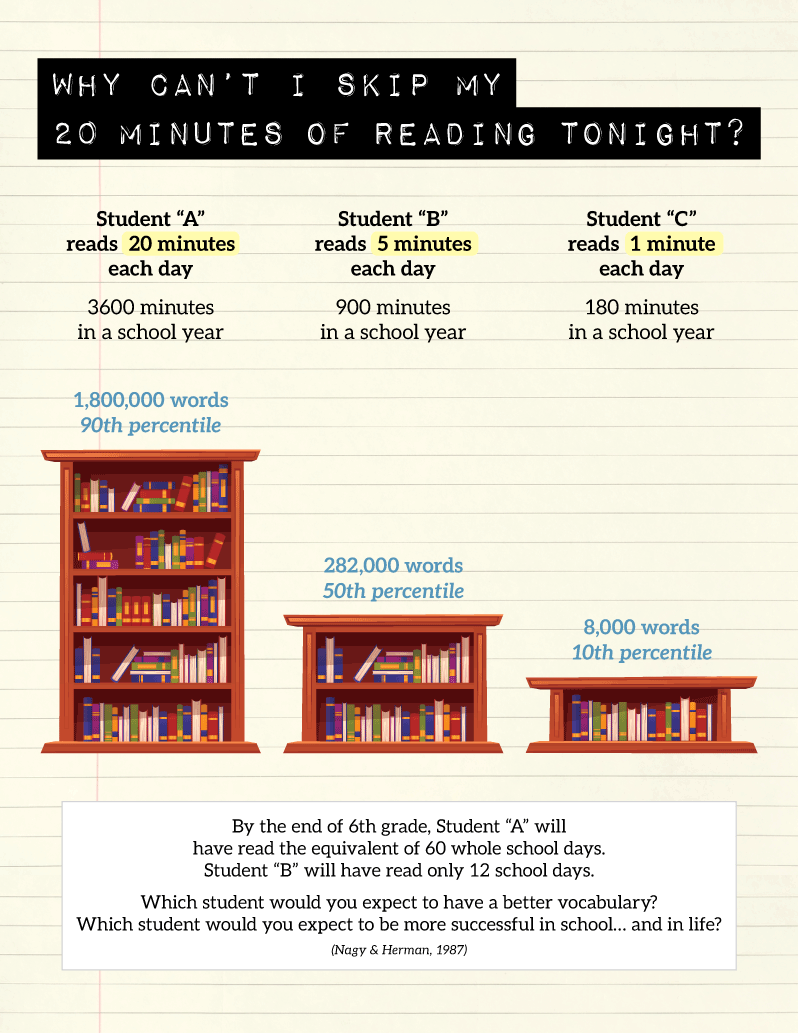
Developing an independent, daily reading habit can lead to significant academic advantages. Teachers often recommend 20 minutes of reading daily as a simple yet powerful way to build these essential skills. The difference between reading regularly and skipping those 20 minutes may seem insignificant in the short term, but over time, the gap it creates in vocabulary, comprehension, and overall knowledge becomes vast.
Let’s take a look at the data:
Creating a Reading-Friendly Environment and Supporting Reading Independence at Home

A supportive home environment plays an important role in helping children become independent readers. Begin by creating a designated reading space that signals reading is a valued daily activity. Choose a quiet, comfortable area with good lighting and minimal distractions. The space does not need to be elaborate. A simple chair or cushion paired with accessible books helps children settle in and focus on reading.
Access to a variety of materials also supports reading independence. Offer fiction, nonfiction, informational texts, graphic novels, and magazines so your child can explore a variety of genres and topics. Choice increases engagement, builds ownership, and encourages children to spend more time in independent reading.
Establish a predictable daily reading routine, beginning with 10 to 15 minutes and gradually increasing as stamina grows. Protect this time by limiting interruptions. Turning off televisions and silencing devices allows children to sustain attention and build the fluency and automaticity that support reading independence.
Families can further encourage independent readers by modeling positive reading habits. Let your child see you read for information and enjoyment, and share what you are reading and why you chose it. Encourage appropriate book selection by helping your child preview a few pages to determine whether a text feels engaging and manageable. If a book is not a good fit, allow flexibility to choose another. This promotes autonomy and sustained interest in independent reading.
Finally, celebrate effort and progress. Focus on consistency, curiosity, and perseverance rather than speed. Reading logs, library visits, or simple conversations about books can reinforce growth and highlight progress toward reading independence. Together, these practical routines create a structured yet supportive environment where children can grow into confident independent readers.
Supporting Comprehension During Independent Reading

Reading independence depends on meaning, not just accuracy. A child may read words correctly yet fail to understand the message. To strengthen comprehension, prompt your child to create a mental image for what they read. When students form clear, detailed images, language becomes more meaningful and easier to remember. Concept imagery questions strengthen the imagery-language foundation rather than focusing on memorization. For example: What are you picturing for what you just read? What does the _____ (for example, princess, building, setting) look like? What do you picture happening next? Encourage your child to describe their mental imagery in detail, focusing on the main action. The goal is a clear, language-described image that reflects understanding. If something is unclear, guide your child back to the sentence or paragraph and ask, “What do you see in your mind now?” Returning to the text reinforces checking for meaning. Over time, students learn to notice when an image is incomplete or inconsistent. These conversations help children organize information, connect details, and strengthen comprehension. As images become more stable and detailed, students are better able to summarize, make predictions, draw conclusions, and retain what they read.
Learn more about how the Visualizing and Verbalizing® program develops concept imagery to improve comprehension and higher-order thinking skills for independent reading.
The Importance of Self-Correction in Independent Reading

A defining characteristic of reading independence is the ability to self-correct. Strong readers notice when something does not look right, sound right, or make sense. They pause and adjust. Self-correction depends on well-developed sensory-cognitive skills. A student must recognize letters and words to decode and create mental images for meaning. When these processes are weak, students may guess, skip unfamiliar text, or continue reading without recognizing a breakdown.
Lindamood-Bell instruction develops the sensory-cognitive processing that makes self-correction possible. As these processes become more automatic, students develop internal feedback systems. They begin to ask, “Did that make sense?” or “Does that match the letters and words on the page?” Rather than relying on adult correction, they check for accuracy and understanding independently. When students can recognize and repair errors on their own, reading becomes active and thoughtful. This strengthens fluency, comprehension, and confidence.
Learn more about how the Seeing Stars® program supports independent reading by developing symbol imagery—the ability to visualize sounds and letters in words—as a basis for orthographic awareness, phonemic awareness, word attack, word recognition, spelling, and contextual reading fluency.
Signs of Reading Difficulties

Recognizing early signs of difficulty can help families seek support and avoid frustration. Watch for the following indicators:
Sounding out words is persistently hard: Your child may struggle to decode words accurately, add or omit sounds, or confuse similar words (for example, reading “steam” for “stream”).
Difficulty learning and retaining sight words: Many common words (for example, “eye” and “thought”) do not follow regular phonetic patterns and should be recognized quickly. A child who struggles may attempt to sound out these words or guess (for example, saying “purple” for “people”).
Slow, laborious decoding: Excessive focus on sounding out every word can hinder flow. A child might decode a word once but fail to recognize it when it appears again a few lines later.
Limited fluency in context: Some children can decode words but struggle to read smoothly, making comprehension difficult. Choppy, effortful reading often interferes with understanding.
Poor spelling: A child may omit necessary sounds (for example, writing “optnrty” for “opportunity”) or spell phonetically without retaining patterns (for example, writing “opertunity” for “opportunity”).
If these challenges persist, consider an evaluation to identify the underlying skills that need strengthening. With the right support, reading can become easier and more enjoyable—key to raising a reader who can read independently and grow into a strong reader.
Support for Reading at Lindamood-Bell
Lindamood-Bell’s evidence-based instruction strengthens the foundational processes essential for reading and learning. By targeting the sensory-cognitive processing that underlies decoding, fluency, and comprehension, we help students develop the reading and comprehension skills that enable independent reading. Our research and results demonstrate that individualized instruction can transform struggling readers into confident, independent readers. Families seeking support in raising a reader can rely on our experience, proven methods, and compassionate team.
If your child shows signs of difficulty with reading or comprehension, our comprehensive Learning Ability Evaluation can identify the skills that need support. This evaluation provides a detailed understanding of your child’s strengths and areas of need and guides the development of a customized plan that addresses the root causes of difficulty. Our intensive one-to-one instruction improves learning, builds confidence, and helps students read independently and develop into a strong reader.
The right intervention can turn reading into a source of pride and lifelong growth. Contact us to learn more or schedule an evaluation.
Key Takeaways for Families
- Make independent reading a daily habit in a calm, inviting space.
- Prioritize choice and interest, since engagement drives progress in raising a reader.
- Balance guided instruction with independent practice to build self-direction and read independently with confidence.
- Watch for signs of difficulty and seek targeted support when needed.
- Partner with Lindamood-Bell to strengthen foundational skills and support your child in becoming an independent reader.
With consistent routines, thoughtful guidance, and effective instruction, your child can become an independent reader who approaches books with confidence, curiosity, and purpose. These tips to make your child an independent reader provide practical steps your family can use at home to encourage independent reading, build lasting skills, and support the growth of a strong reader over time.