


article
Research Articles


Small or absent Visual Word Form Area is a trait of dyslexia

Conducted in collaboration with LBLP, this study from Stanford University investigated how the brains of dyslexic learners adapt to reading interventions over time. The study focuses on whether differences in the visual word form area (VWFA)—a crucial region in the left ventral occipitotemporal cortex (VOTC) responsible for recognizing written words—are a stable trait of dyslexia or if they can change as struggling readers improve with targeted interventions.

The study included 44 children with dyslexia, who completed 160 hours of the Seeing Stars program (delivered remotely during the summer for eight weeks due to the COVID-19 pandemic), and 46 control children, 21 of whom had dyslexia and 25 without. These participants underwent functional magnetic resonance imaging (fMRI) and behavioral assessments at five different points throughout the year. 

The analysis compared the brain regions in two different ways: first, at the beginning of the study, to examine differences in their presence, size, and function among participants with varying reading abilities, and second, over time, to explore how these regions changed as reading skills improved.

The findings revealed that dyslexic readers show significant differences in VWFA presence, size, and tuning properties compared to typical readers. The study confirms that while the intervention led to statistically significant improvements in reading skills and increased VWFA size, dyslexic readers still exhibit smaller VWFAs than their typical peers. This suggests that abnormalities in the VWFA may be a lasting trait of dyslexia. Perhaps with sufficient intervention that closes the reading skill gap, dyslexic readers are expected to have smaller VWFAs. The research highlights which aspects of brain function can change through intervention and which remain stable, offering valuable insights into the neurological basis of dyslexia.
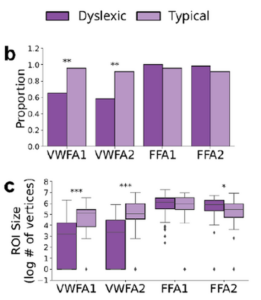


b, Proportion of participants with usable data who had a VWFA or FFA of any size present at baseline in typical (light purple) and dyslexic (purple) readers for each ROI. 

c, Log transformed size (in number of vertices) at baseline in typical and dyslexic readers for each ROI. 

Connect with us
If your child has dyslexia, accommodations may help them get through the school day. But what about building real reading skills?
Our latest blog explores common school accommodations and why developing sensory-cognitive skills is essential for independent reading. 
🔗 Read the full article at the link in bio, @lindamoodbellofficial.
Start 2026 Strong with Workshop Savings ✨

Kick off the year with special pricing on Lindamood-Bell for Schools professional development, aligned with the Science of Reading.
✔ Save 25% when you bring a colleague or bundle workshops
✔ Group inservice training discounts up to 25% available

Use code HELLO26BOGO

⏰ Offers end January 31, 2026.
👉 View the workshop schedule and reserve your spot.
🔗 Link in bio @lindamoodbellofficial
✨ Experience the Lindamood-Bell Academy Difference!
 
📅 Jan 12–16 | Academy Week
See firsthand how we help students build their learning ability while thriving in a full academic curriculum.

🎓 Special Enrollment Offer available!
 Tap the link in our bio @lindamoodbellofficial to learn more.
📚 Teaching students to connect language with imagery strengthens reading skills and comprehension.

At Lindamood-Bell, our approach is grounded in Dual Coding Theory (DCT), a cognitive framework explaining how the brain processes information. Our founders’ programs, including Seeing Stars for reading and spelling and Visualizing and Verbalizing for comprehension and critical thinking, apply these principles through sensory-cognitive instruction.

✨ See how our approach translates into classroom practice and the real results it produces for students.
Read the full article - tap the link in our bio, @lindamoodbellofficial.
📖 Want to help your child build strong reading skills from the very start?
Our latest blog, Developing Early Literacy Skills: A Parent’s Guide to Supporting Young Readers, shares practical tips for nurturing language, decoding, and comprehension at home. Discover how everyday reading and playful activities can spark curiosity and confidence.
✨ Learn how personalized support at Lindamood-Bell can strengthen the foundational skills your child needs to succeed in school and beyond.
Tap the link in our bio, @lindamoodbellofficial.
As we close out the year, we’re grateful for the trust you place in Lindamood-Bell and for our shared commitment to helping individuals learn to their full potential. 
Wishing you a holiday season filled with rest, joy, and connection, and a 2026 full of inspiration and possibility.
See the difference the right instruction can make. 💙
Miss Georgia’s Teen, Carrington Manous, shares how dyslexia once left her feeling discouraged about school and learning, and how Lindamood-Bell helped her build the skills and confidence to succeed. Today, she uses her voice to advocate for students with learning differences and to expand access to effective instruction.
🎥 Watch Carrington’s full, inspiring story. Link in bio at @lindamoodbellofficial.
Parents, ❄️ Winter Break ❄️ is a great time to give your child a boost. For a limited time, enjoy 10% off instruction. Contact your Learning Center to get started!
❄️ Don’t miss our Winter Wonderland Learning Savings!❄️
📚 10% OFF instruction during Winter Break!
Help your child catch up, conquer learning loss, or get ahead. Our individualized instruction will set them up for success and confidence in the New Year.
👉 Visit our website for details and to get started today! Follow the link in our bio, @lindamoodbellofficial.
See the impact our Lindamood-Bell instruction can have! This family shares how our evidence-based approach helped their child thrive. 🎥 Watch their full story and get inspired. Follow the link in bio, @lindamoodbellofficial.

❄️ Parents, winter break is the perfect time to give your child a boost! For a limited time, enjoy 10% off instruction. Contact your Learning Center to get started!
Our free webinar featuring Paul Worthington, Director of Research and Development, is now available to watch.
Learn how evidence-based instruction, the Cognitive Science of Learning, and effective leadership strategies can help drive meaningful, sustainable improvements in student learning.
▶️ Watch now at the link in bio, @lindamoodbellofficial.
Reading fluency isn’t about extra drills or repetition.

It grows when students strengthen the sensory-cognitive foundation behind accurate, automatic reading. 

Symbol imagery is key. Visualizing sounds and letters in words helps students:
 • Decode accurately
 • Recognize words automatically
 • Enjoy reading

Discover why symbol imagery matters and how educators can build fluency. Read the full article at the link in our bio, @lindamoodbellofficial.
📣 Attending the SENIA International 2025 Virtual Conference?

🎓 Don’t miss our session:
Join Melissa Garner, Director of Lindamood-Bell for Schools, for “Closing the Comprehension Gaps in the Science of Reading” on November 21, 1:30–2:45 PM. Melissa will explore how developing concept imagery builds comprehension, vocabulary, critical thinking, and writing. 

💻 Visit Our Virtual Booth:
Stop by the Lindamood-Bell booth to learn more about our sensory-cognitive approach and how it supports educators in helping all students reach their learning potential.

Get more info at the link in our bio, @lindamoodbellofficial.
Educators, join us for a free Lindamood-Bell webinar with Paul Worthington, Director of Research and Development.
Discover how evidence-based instruction, the Cognitive Science of Learning, and effective leadership strategies can drive meaningful, sustainable improvements in student learning.

🗓 Wednesday, December 3rd | 11 am PST | 2 pm EST | 7 pm GMT

Can’t join live? Register anyway, and we’ll send you the recording!
Link in bio, @lindamoodbellofficial.
Request Information

Request Information

When you complete our form, we'll send you to our digital information packet and reach out to you shortly.
You may also call us at


* required

Schedule a Learning
Ability Evaluation

Please fill out the form and we will be in touch to schedule an evaluation.

* required