



The role of brain activity in characterizing successful reading intervention in children with dyslexia
The role of brain activity in characterizing successful reading intervention in children with dyslexia
Krafnick, A. J., Napoliello, E. M., Flowers, D. L., & Eden, G. F. (2022) Frontiers in Neuroscience, 16. doi=10.3389/fnins.2022.898661
Studies of reading intervention in dyslexia have shown changes in reading performance and in brain function. However, there is little consistency in the location of brain regions associated with successful reading gains in children, possibly due to variability/limitations in methodologies (study design, participant criteria, and neuroimaging procedures.
Using a randomized, crossover design, 31 children with dyslexia were assigned to a phonological- and orthographic-based tutoring period as well as a within-subjects control period to examine: (1) intervention induced changes in behavior (reading performance) and in brain activity (during reading); and (2) behavioral and brain activity pre-intervention data that measured and predicted intervention-induced gains in reading and mathematics performance. More specifically, the children were randomly assigned to one of three groups. Each of the three groups received the same six-week reading intervention, with two of the groups receiving a counterbalanced math intervention. The third group received the reading intervention only.
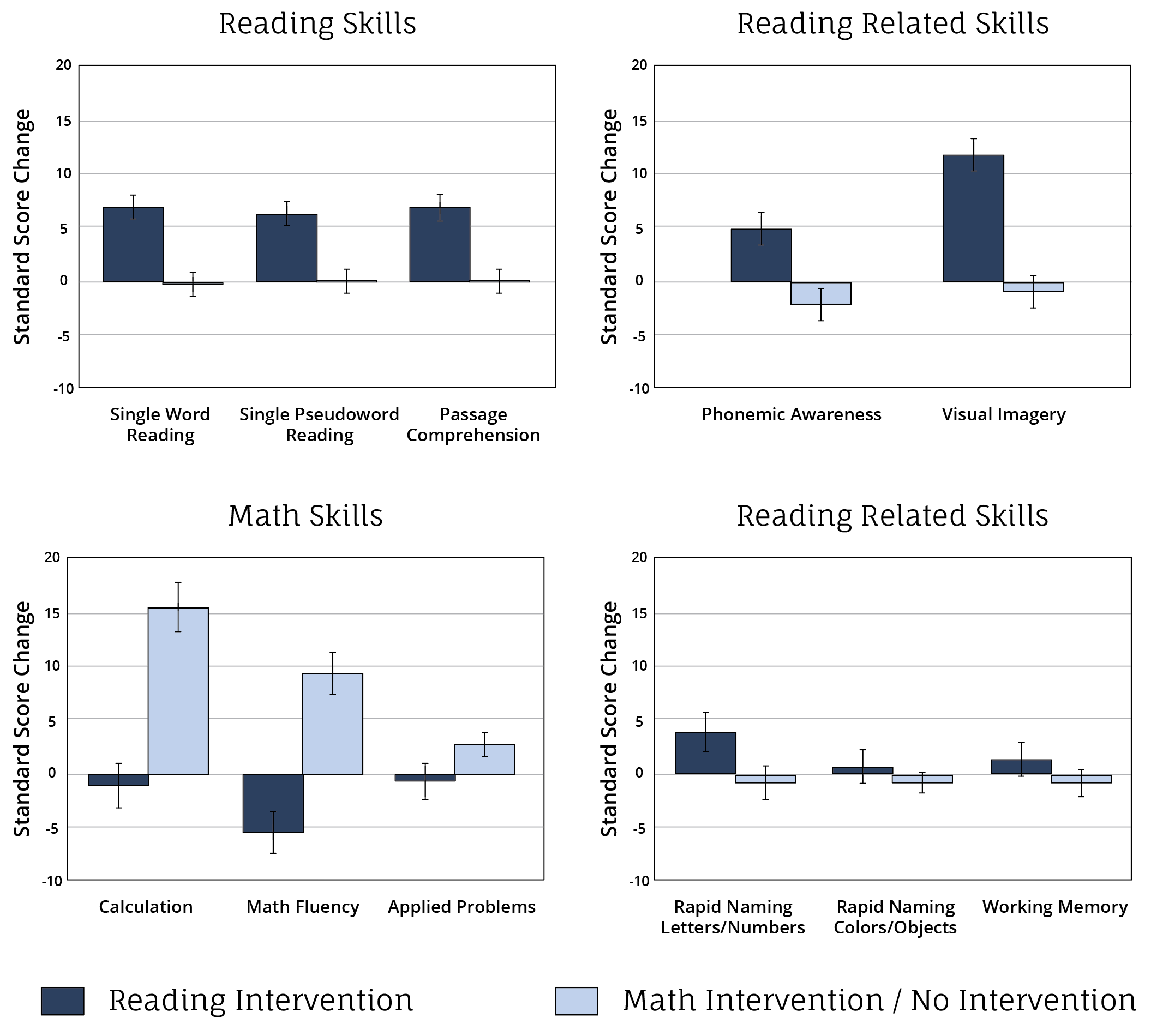
While there were significant gains in reading intervention for the three groups, it was surprising that the control groups also received the math intervention, which showed significant gains in reading (Figure 2). Specifically, regarding math, there were significant main effects of Time Point for the measures of mathematical computational ability (W-J Calculation), timed arithmetic (W-J Math Fluency), and mathematical word problems (W-J Applied Problems), with all measures increasing over this time period. The first two results remain significant after the Holm-Bonferroni correction, demonstrating that the math intervention was successful and specific in bringing about gains in the math domain.
Notably, gains were observed on all three measures of reading, specifically single-word reading, pseudoword decoding, and reading comprehension (Figure 2). No such gains occurred in the same children following their control period, where some were engaged in a math intervention (active control), while others received no intervention at all (null period for developmental control). Importantly, an ANOVA confirmed that gains in single-word reading performance following the reading intervention were significantly different from any changes in single-word reading following the math intervention. As such, we can be assured that the reading gains can be unequivocally attributed to the information learned during the reading intervention and were not due to domain-general effects, such as attention or the result of a placebo effect. Lastly, these behavioral gains were independent of sex, demonstrating no sex-specific effects on intervention-induced gains in reading.
The benefits of the intervention appeared to have longevity, as the standard scores were maintained a year later (as a function of their raw scores increasing), indicating that the students’ progress since the intervention ended was of a magnitude that is consistent with that of all children in their age group based on this normed testing instrument.